

Millions of people visit museums every year enjoying exhibits across a multitude of topics. For museums in the Midwest, the folks at Edwards Creative in Milan are responsible for many of the displays.
The company was launched in 2005 by Cathy and Steve Edwards, the latter of which came from a graphic design background.
"He worked at two other places prior to starting this, in companies very similar, but we just knew there was a better way," said Cathy Edwards, now the CEO of the company. "He decided to open up the company and start building from there."

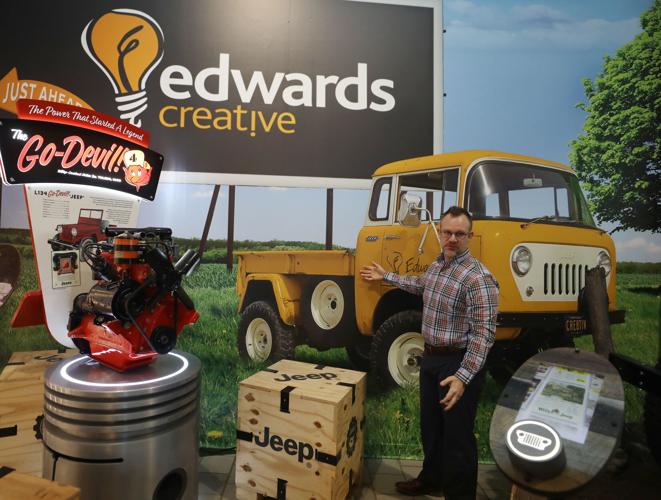
Tim Wren, Director of Museum Services for Edwards Creative shows one of their many displays on Monday, January 29, 2024, in Milan.
When the doors first opened in Milan, Edwards Creative had two employees: Cathy and Steve Edwards. Fast forward 19 years and the company is well on its way to 40 employees and doing everything from graphic design and project management to construction and fabrication.
People are also reading…
It all happens under one roof at 435 1st Street East in Milan. Edwards Creative has three main divisions: corporate environment settings, trade-show booths and museum services.
When the company first opened, it was mostly focused on the first two services. It was not until 5 years ago that the Edwardses decided to hone in on the museum services and bring it on as a mainline offering.
"That was something we decided to engage in several years ago because it's exciting work that team members want to be engaged in," Edwards said. "It's creative, it's inspirational, it's educational and it stretches our creative muscle a little bit. It's a different way to design and look at spaces."
From start to finish, the team helps clients take their idea and turn it into a tangible design. Edwards Creative then builds, paints and perfects it all in house. They even have a fleet of vehicles to deliver the products across the Midwest.
In the Quad-Cities, Edwards Creative has done a number of projects including the signage for the John Deere Classic, a leg of the PGA Tour held annually in Silvis. Community involvement is a big foundation of the company, Edwards said.

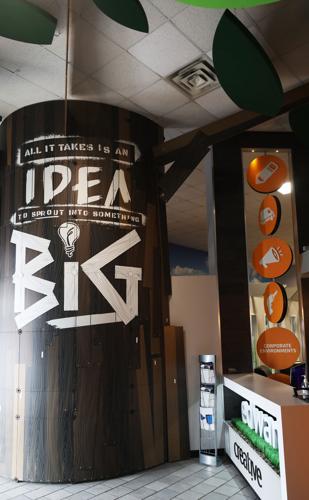
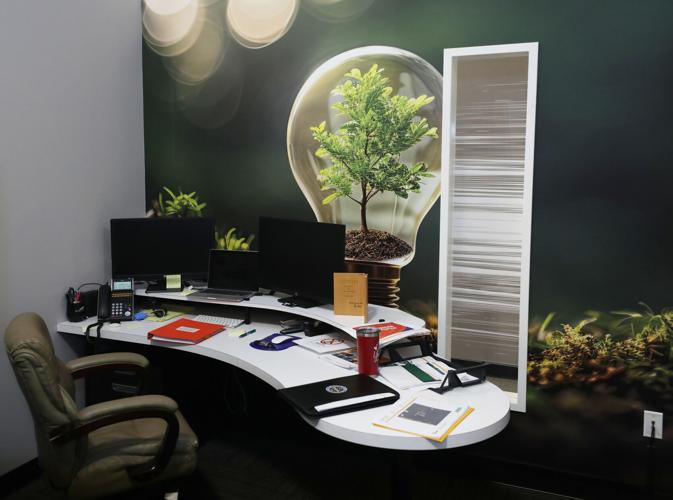
A peek inside one of the newly finished offices at Edwards Creative in Milan.
"We have been incredibly engaged in the community and supported a number of organizations, served on many different committees," she said. "Steve and I always felt it was our corporate responsibility to pay it forward in the community so we get involved, and through that we have met so many terrific people throughout the years and they become clients of ours."
Referrals are another big part of the business. Director of Museum Services Tim Wren said the company has a partnership with the Iowa Museum Association, which has pushed Edwards Creative into being one of the most desired companies when it comes to designing exhibits.

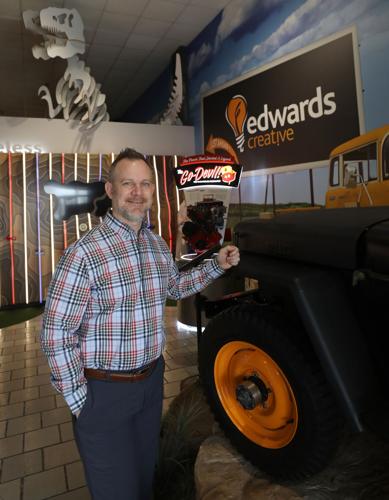
Tim Wren, Director of Museum Services for Edwards Creative is pictured in their lobby on Monday, January 29, 2024, in Milan.
Wren said once a museum comes to them with an idea, there is a three-step process to getting to the finish line: conceptual design and planning; final design; and production and installation. The conceptual part consists of working with the client through a series of worksheets, meetings, site visits and going through the history of the exhibit to discover the storylines and themes the museum wants to showcase. This process alone can take five or six months, he said.
Edwards said this step is crucial and is where the collaboration between the team at Edwards Creative and the museum shines.
"We're a storytelling business," she said. "Whether it's a company with their brand or it's at a museum. Even if it's at a tradeshow and you have five seconds to get somebody's attention, there has to to be something that evokes some emotion or interest in your story."
Wren agreed, saying there are a variety of factors that go into the concept. At the start, the focus is on which medium — wall graphics, a custom build or a digital display, to name a few — to use to tell the story.
"Everything gets paired down until you have your idea and then you have to figure out how to bring it to life," he said.
Once the design is ready, the Edwards Creative team gets together to discuss the fine details: measurements, lighting, access to spaces, ADA compliance, timeline — and the list goes on, Edwards said.
A recent project in the Edwards Creative studio was for the Ames Historical Museum, which will be installed on the second floor of its building in downtown Ames.

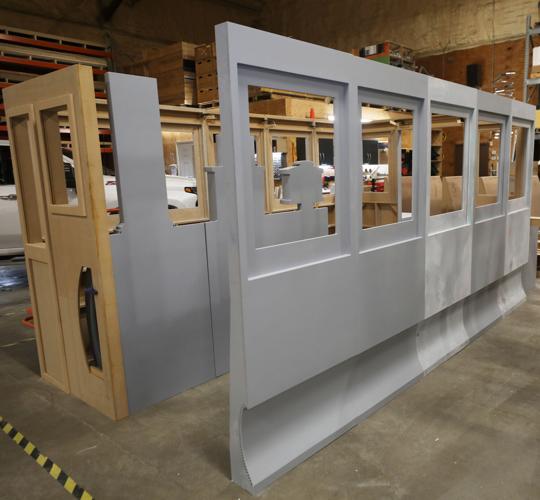
A replica of a trolly car takes form at Edwards Creative on Monday, January 29, 2024.
The city is home to Iowa State University, which opened as the Iowa Agricultural College and Model Farm in 1869 according to the university's website. To transport students from campus back to Ames, the Ames Street Railway Company, also knows as the College Railway, developed a local line.
The Motor Line, as it was named, was more commonly known as the Dinkey, according to the Ames History Museum. That train made its first pass between downtown Ames and the campus on July 4, 1891.
In order to tell the story of the train and its cultural significance, the Edwards Creative team decided to build an exact replica for the museum. Following historic measurements and ensuring the parts and pieces would fit the space was one thing.
Making sure it could be delivered successfully was another.
The exhibit will be on the second floor of the building, meaning the construction team at Edwards Creative had to pay particular attention that all 10 pieces of the train would fit in the elevator in order to be transported to their new home.

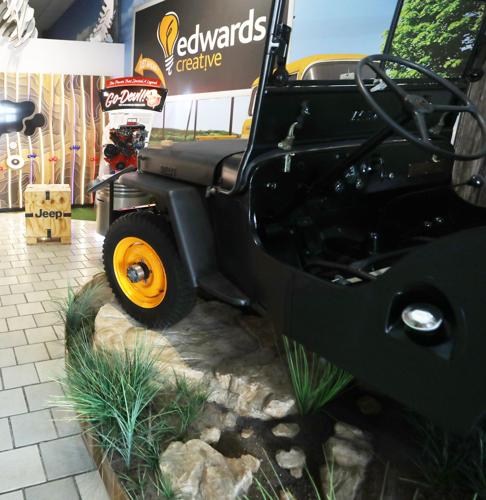
A Jeep climbing the rocks is on display in the lobby of Edwards Creative in Milan.
Wren credited his team for thinking of every step along the way, including measurements and accessibility. That creative muscle has to be flexed when it comes to choosing materials as well.
Sustainability has become a major conversation in the museum world, with special attention to the mediums exhibits are made of. Additionally, special attention has to be given to the items on display.
For example, Wren said, artifact cases cannot be painted because the off-gassing from the paint could have a harmful effect on the artifacts inside. Edwards echoed that, saying certain pieces need to be out of direct sunlight in order to protect them, and that is taken into account during the design phase.
"There's also conversations now in the museum world about what stories to tell and what artifacts to show," Edwards said. "There's cultural sensitivities we have to consider along with the curator at the museum. As times change and conversations change, we have to consider what's appropriate."

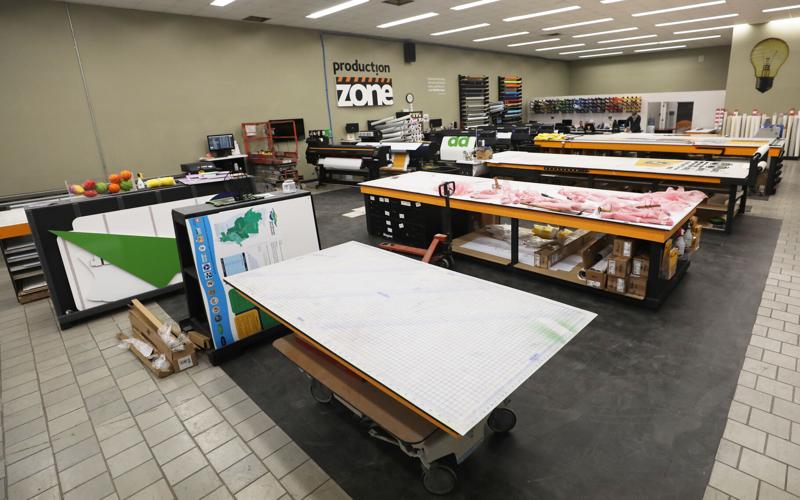
The printing area in Edwards Creative in Milan.
Wren said while creative exhibits the team has to become "mini-experts" on the subject matter in order to work with the museum curator to create the best possible outcome. Because every project is different, every day is different. That is a major selling point for new hires, Edwards said.
"We have a lot of creatives who want to work here because they'll never do the same thing twice," she said. "You have to have a great sense of humor and be fun, engaging. You have to want the challenge of learning all about an artifact and what is the best way to (display) it for storytelling."
The challenge and variety in the work is what keeps Wren coming in the doors everyday, he said. From a sports museum to a nature conservatory, the work is the same but the details and challenges always differ.
Edwards said another key factor in what makes her job fun is the people she meets along the way. Those who have a deep understanding and love for their work are open to sharing and makes the collaboration piece easier.
"Museum curators are people who have dedicated their lives to telling the story of their museum," she said. "They are passionate and they are invested passionate clients and that also creates an amazing experience for us."

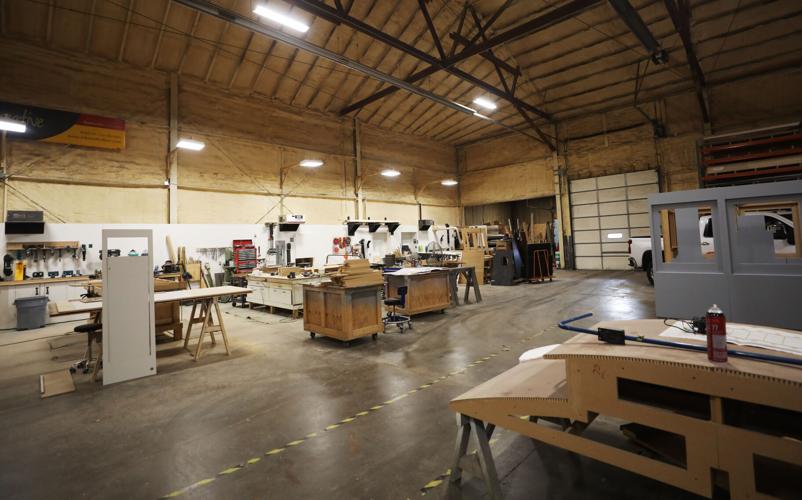
A section of the production area of Edwards Creative is pictured on Monday, January 29, 2024, in Milan.
At any given time the team is taking on a few hundred projects at once. But, Wren said, they are not all massive undertakings like museum exhibits.
About 75% of the projects have a life-cycle of two to four months, Edwards said. Those are smaller projects such as logos, branding and displays. The other 25% have a life-cycle of two years, which are the larger projects like exhibits.
"Our workload is full, so that means whoever comes to Edwards embraces the challenge of balancing a number of different project with vastly different content," she said. "You have to want to work here and have a variety of projects that may have very little to do with each other."
Every person on the team, from the creatives to the industrial designers to the fabricators all work together to complete the final project.
"When a creative wants to see how it's being built they can walk in the back and see what was in their mind's eye a month ago," she said. "That's what's so cool about it. It was in their mind a month ago and now it's completely built and they get to see it through the entire process."

A large display rises to the ceiling of Edwards Creative in Milan on Monday, January 29, 2024.
All of that translates into immense pride in work, Wren said. Going to ribbon cuttings or site visits after an installation is a great feeling, but watching people enjoy it heightens the feeling.
"Knowing you're going to have an impact on people through the stuff that you're creating is pretty wild," he said. "I've had my kids go with me a few times to ribbon cuttings and there's self-pride there being able to say 'Dad did that.'"
Shortly after more focus and resources were poured into the museum side of the company, the COVID-19 pandemic hit. But it didn't slow down the Edwards Creative team one bit.
"We were in the process of working on a number of museum projects so there was a great deal of conceptual work going on during COVID," Edwards said. "Even though we couldn't have all our employees in and working on-site, they were able to do a lot of creative and conceptual design for these projects at home."
As soon as it was safe to return, the work came pouring in.
"When we came back from COVID, the doors blew off and we went 100 miles per hour since we got back in our seats from that," Wren said.
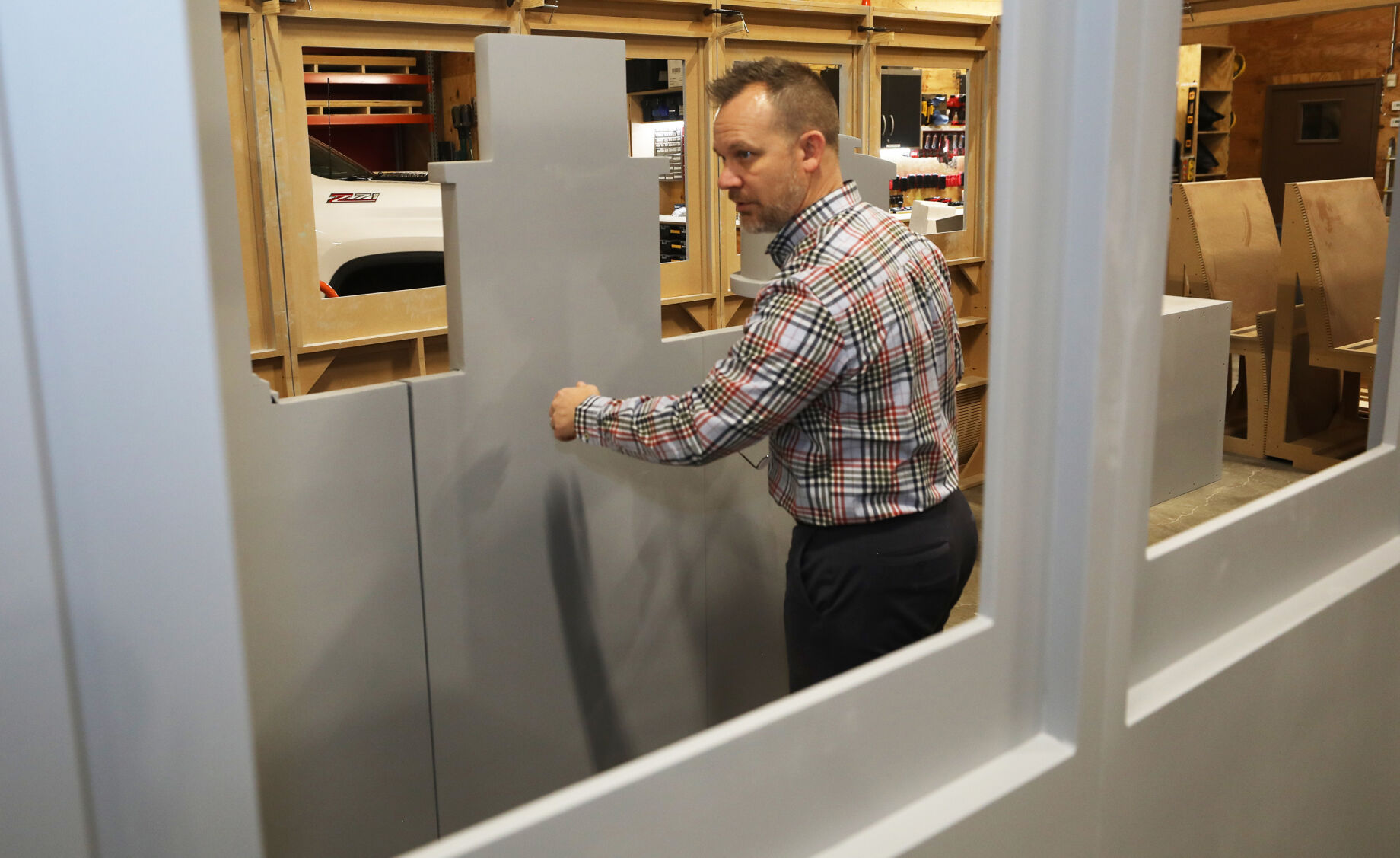
Tim Wren, Director of Museum Services is pictured inside a scale replica of a trolly car at Edwards Creative, on Monday, January 29, 2024.
Edwards said she was not surprised by the amount of work but welcomed it because it sparked a new appreciation for culture and the arts.
"COVID reminded communities across the country how much they appreciate and benefit from the cultural amenities in their town," she said.
While cooped up at home, people remembered the fun and enrichment museums provide. This also afforded museum curators the time to re-think their exhibits and dream up what could be accomplished next.
"When he said the doors blew off it's because these museums were getting infused with donations and grants and the directors had been sitting and working through conceptual ideas for their galleries so it was a perfect scenario for the museum industry to thrive post-COVID," she said.
Edwards Creative thrived, too, opening an office in Dyersville in July, 2023. With a plethora of accomplishments under its belt, Edwards Creative is also Woman-Owned Business certified by the Women's Business Enterprise National Council, which has opened doors to projects the company otherwise would not reach, Edwards said.
But it's inside the doors where the magic happens and is why those at Edwards Creative say not just the work but the people make every day better than the last.
"This is the best boss I have ever worked for," Wren said. "There's nobody I would rather work for than Cathy."
The Human Remains Protection Act, which Illinois Gov. J.B. Pritzker signed last month, complements a 30-year-old federal law requiring the repatriation of human remains and funerary, sacred and cultural objects that were unearthed in the course of European development of former Indian lands. The bill would streamline the process through which Illinois returns Native American remains and materials to their communities. In part, it would create a procedure in which the Illinois Department of Natural Resources would consult with affiliated tribal nations when returning remains. The bill also approves the construction of a cemetery on the grounds of the Illinois State Museum, in order to facilitate the reburial of ancestral human remains held by the museum.