


Zimmerman Honda sells cars rain or shine, but sunny days are especially beneficial for the dealership.
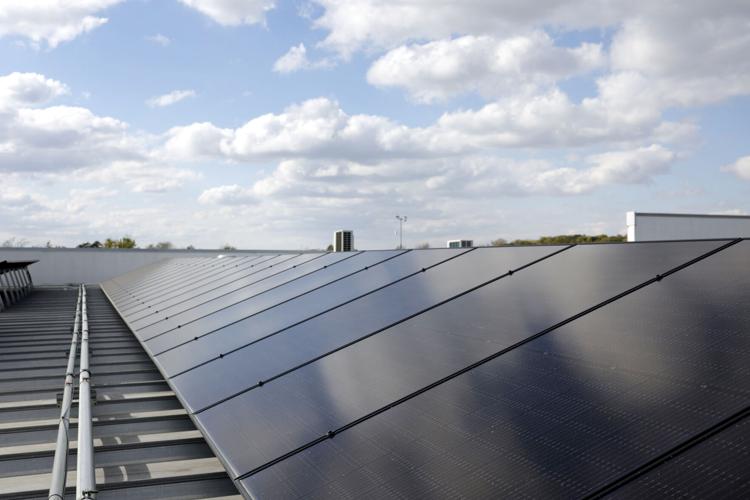
On top of Zimmerman's building at 7030 44th Ave. in Moline are hundreds of solar panels that help the dealership stay energy efficient. Detail Operations Manager Eric Waldman said the decision to go solar was in the works for some time before the array went live in March 2023.

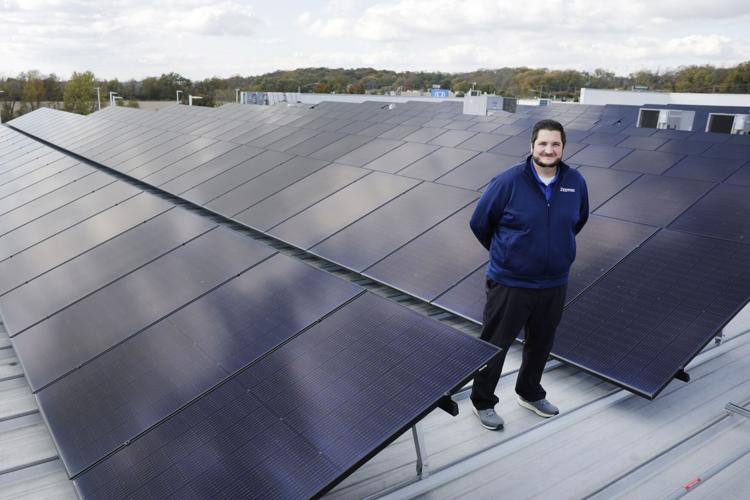
Eric Waldman poses for a photo among the solar panels on Zimmerman Honda's rooftop on Wednesday, Oct. 29, in Moline. The 690 panels, two invertors and optimizer were installed in late 2023.
The idea had been tossed around a few times, with various sales representatives coming by to discuss the idea. With the federal government and the state of Illinois offering incentives, the time seemed right, Waldman said.
The Illinois Shines program specifically was a big pull, he said, because it allowed Zimmerman to sell solar renewable energy credits back to the power company.
People are also reading…
In Illinois, utilities must purchase the credits to meet their obligation to supply a certain amount of power from renewable energy projects to comply with the Illinois Renewable Portfolio Standard, according to Energy Equity Illinois. The RPS is a policy designed to increase the development and use of renewable energy sources for electricity generation.
"It wasn't just the financial savings that made it make sense as a business decision, but it was the community impact," Waldman said. "We know as electric cars become a bigger thing as time goes forward, those (energy) needs are going to increase. We just wanted to participate in that. It was one of those things that makes business sense, and because it's for the planet and good for the community that we decided to proceed, as far as being energy efficient."

The panels, which have a 30-year lifespan, will start paying for themselves around the 12th year.
The solar panels might have been the latest step toward efficiency for Zimmerman, but the dealership has been practicing good habits for years, said chief compliance officer James Craig. When the company built its current building in Moline, efficiency was at the forefront.
The dealership has been around since 1952, originally opening in Moline. Ten years later it moved to Rock Island where it stayed for decades. In late 2011, owner Mark Zimmerman announced plans to move back to Moline, to the location at 7030 44th Ave.
In addition to ensuring there are separate containers for garbage and recyclable materials, Zimmerman switched over to all LED bulbs a few years ago. But efficiency was in mind even as the new building was being constructed.
The building was specifically designed to have heated floors from the used oil collected in the service department. When cars are brought in for repairs, the used oil goes into a separate bin that is stored up for winter to help warm up the building, and the sidewalks surrounding it.
"That oil goes all the way up front, inside and underneath the building and heats our floors inside and the outside pad," he said. "If we would have snow or ice out there, we turn the outside pads on and that waste oil is used to heat it out there, instead of water."
With the building itself being nearly 40,000 square feet, keeping it energy efficient is a tall order. But its size also makes it the perfect place for solar panels, effectively raising Zimmerman's energy efficiency levels.
After making the decision to go with solar, Waldman said, the first step was to meet with the power company, MidAmerican, and sign agreements for the new array. Before the panels could be installed, he said, MidAmerican had to install its own equipment to make sure the solar panels were connected to the company's grid.

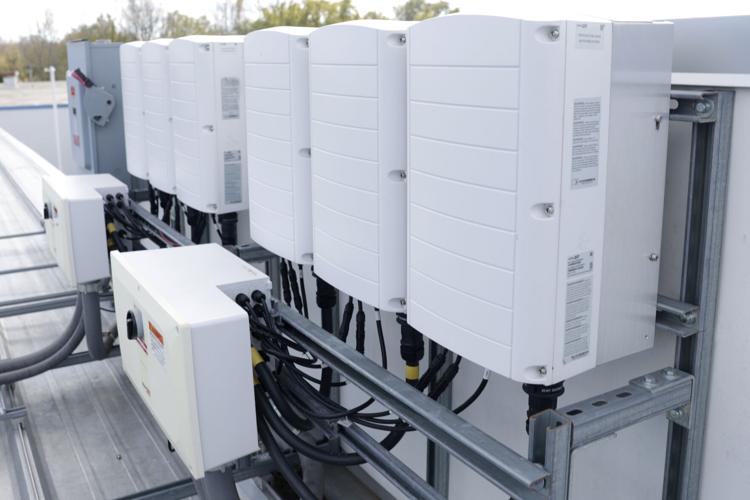
Two inverters, which convert the sunlight into electricity, were installed next to the solar panels.
With approval from MidAmerican, the panels were ready to be installed. All 690 panels and two inverters were installed on the roof and ready to go in less than a week, Waldman said.
"And then we flipped the switch a little bit after that," he said.
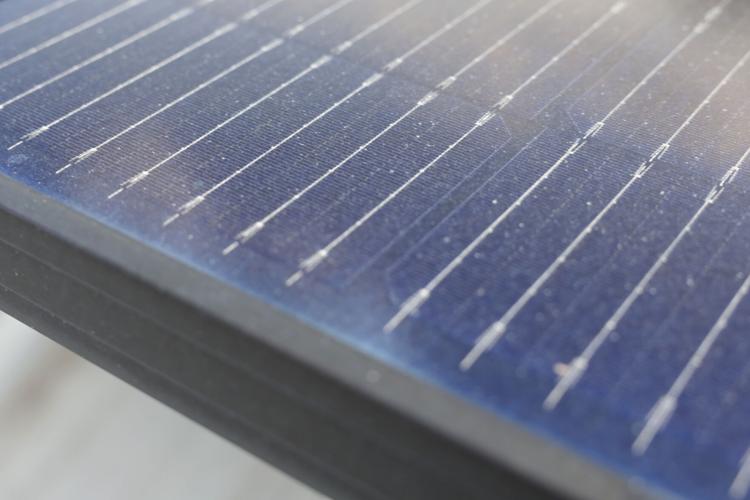
The panels themselves weigh about 40 pounds apiece and are about 65 inches long by 39 inches wide. They require no batteries and are built to sustain strong winds, hail and storm damage.
At Zimmerman, the panels are arranged in rows and tilted up, allowing for workers to get in between them if necessary. On the ground, rows of cables are bunched together and covered by metal piping to protect them from the elements.
The solar panels work by collecting energy from the sun, which is then transferred to the two inverters on the corner of the roof. Those inverters take the solar energy and convert it into actual energy that is then transferred into the grid.
Waldman said they also have optimizers installed, which help diagnose where a problem is, if one were to occur. Without the optimizers, workers would have to unplug each panel one by one to find the problem, he said.
Inside the building, workers don't notice a single change. That's by design, Waldman said.
"That's mainly because the electricity from the panels are not going into the building, they're going into the grid," he said. "So it really doesn't impact what we do here one iota."
Even in the event of a storm, he said, there's no concern about damage.
"If anything, they provide protection for our roof because then it's going to take the brunt of everything and not the roof," he said.
With the power generated going directly into the grid, the financial contributions are immediate. On the bill, Waldman said, it shows the power generated by the solar panels and below that the power going out — or used by Zimmerman.
"The difference between those two is what they bill you on," he said. "You see on your bill how much power you put into the system (because) the meter works both ways. That way we know exactly how much the solar produced and how much we're responsible to pay for."
Most of the time, especially in the summer when the sun is out most, the only thing Zimmerman is responsible for is the $120 a month connection fee, Waldman said. The panels and the power are virtually paying for themselves.
Zimmerman's system was designed to cover 98.6% of the company's need, Waldman said, but that number is cyclical throughout the year because logistically, the panels produce a lot more in the summer than they do in the winter, he said.
Everything is monitored by Zimmerman, Eagle Point Solar and MidAmerican, Craig said. In the lobby at Zimmerman is a large TV that shows customers how much solar is being generated in real time.
Craig said the end goal is to produce as much power as the building consumes, to be at a net zero. The more power they can put back into the grid, he said, the less MidAmerican has to worry about overproducing from other sources.
Being aware of how much power the dealership consumes was a key factor in deciding to go with solar, Waldman said. As a Honda dealership, Zimmerman was preparing for a new line of electric cars that would inevitably require the dealership to use even more power for the required charging stations.
"We assumed that our electric costs would drastically increase over time, so (the solar) was something to try to offset those costs that we were looking at from a business perspective as we were investing," Waldman said.
With the panels having a lifespan of 30 years and them presently covering about 80% of Zimmerman's cost, the company is looking to have the investment paid off in about 12 years, which leaves 18 years of savings on the table, Waldman said.
It's a great payoff, considering the initial investment is fairly hefty and needs to be paid in full. Waldman said he feels that upfront cost is what scares most companies away, but the return in investment is worth it in the end for both the business and the community.

Eagle Point Solar from Dubuque, Iowa, installed the panels within four days.
Speaking from a dealership perspective, Waldman said if the US ever gets to the point of 50% of cars being electric, the country does not produce enough power to charge them all. The power capacity needs to increase, and installing solar panels to help produce more power definitely helps.
Craig added the maintenance on the panels is at a minimum because Eagle Point Solar is constantly monitoring. It's been nearly three years since the panels were installed, and so far they have had only one minor issue.
The company was able to identify and fix the issue quickly without disturbing the business side of Zimmerman or the rest of the array. That peace of mind is a big motivator to take on a project like this, Waldman said, but he also encouraged other business owners to look at the stability solar panels can provide.
Power is something every business needs and by paying less in power bills every month, it allows for flexibility to invest in other things, he said. And it allows for an investment in the company's future, as well as the community's.
"If you're looking at it from a business perspective, capital is a real thing and it's really hard to quantify but I think that's something that you can't underestimate: how much that means to be a member of the community," Waldman said. "When people know that you've been here for a while and you're planning on being here for a while because you're making these investments, it truly is a community investment because that power goes to the community."
Honda is set to return to Formula 1 as an engine partner for the Aston Martin F1 team in 2026.