


Rodney Levsen Sr. did not fall in love with music at first sight, but at first listen.
“I was in Madison School the first year after it opened, and we had a music teacher out there that was a great piano player,” he said.
It was 1941 and Levsen was six years old. The music room at Madison was on the top floor of the school and was accessed by a large staircase.
“This lady would go in and she would, especially at the noon hour when we were all at lunch, play Warsaw Concerto, and she could really play it,” he said. “The music would come out and roll around down the hallway. It just raised goose pimples on my arms and I thought, ‘This is for me.’”

Rodney Levsen Sr. shows off his shop at Levsen Organ Company, which he and his wife, Colleen, bult in the '80s, on Friday, Oct. 6, in Buffalo. The company, which employs 10 people, builds, rebuilds and tunes organs.
From there, Levsen’s love of music grew and he took piano lessons throughout grade school. Once he reached high school, he found a job at a Presbyterian church in Davenport, working in the maintenance department.
People are also reading…
“Of course, they gave me a big key for the entire church, because I had to get into the various different rooms,” he said. “And then when I finished, I took the opportunity to go into the sanctuary and turn on the organ and play it.”
As Levsen tells it, “One thing led to another,” and his love for the organ flourished. With his sights set on attending college, he searched for a job that would earn him a bit more money and landed one with a piano company in Davenport.
“I learned how to tune pianos and tune electronic organs,” he said. “I decided that at some point in time, I would move out of piano tuning, and maybe get into the pipe organ field.”
Once he got the hang of things, Levsen decided to branch out on his own and freelance his services. Word spread, and he soon began fielding phone calls from churches, asking him to look at their pipe organs.
Through that job, he landed another one. Levsen had to call the Wicks Organ Company in Highland, Illinois, to order parts for the organs he was working on.
“The second time I called the vice president of the company got on the phone and said, ‘Rod, what kind of work are you doing up there? We’re looking for a representative in Iowa and Illinois. Would you be interested?’” he recalled. “’I said well yes I would!’”
That phone call turned into a 10-year career as a representative where he sold 80 organs across both states. In addition, Levsen served an apprenticeship and began tuning organs in the Quad-Cities metro area. Before long, his territory expanded to eastern Iowa and western Illinois.
In the late ‘70s, Levsen decided he had the experience to go into business for himself, but with a twist. This time, he decided to build pipe organs from scratch.
“The first organs were built in my then-new garage in Davenport, but I knew that wasn’t going to work for very long,” he said. “So we looked for the land and bought down here in Buffalo, built the building and that’s how we got our start.”
Learning the ins, learning the outs
Levsen’s oldest son, Rodney Levsen Jr., got involved in the family business right away and is now the vice president of the company. He started working with his father when he was seven years old.
“I would go out and hold keys for him, hand him screwdrivers, stuff like that,” he said, adding he learned the tuning process at about the same time. “I’ve been tuning for over 50 years now.”
Levsen said his son’s interest in construction and woodworking is what got him in the door, and is a prerequisite for those looking for employment at the Levsen Organ Company.
“There are 14 different skilled trades involved in building a pipe organ, and a master builder has to know something about all of those,” Levsen said. “Well, maybe a little more than something.”
In order to master all those trades, an organ apprenticeship is an eight-year-long adventure.
In the early ‘80s, Levsen got his first order for an organ. He had been tuning the existing organ at First Lutheran in Cedar Rapids when they called and ordered an upgrade.
Two years later, it was finished and installed. Once it was all in, Levsen met with the organist, an old friend of his.
“He said to me, ‘Rod what are we going to call this organ?’” he recalled. “I said ‘well, I guess it’s a Levsen organ.’ And that became our name.”
By the late ‘80s, business was booming and the Levsen Organ Company had as many as 18 employees. It now has 10, but that even number is important, he noted, because organ tuning work is a two-person job. Building one from scratch takes even more help.
In the decades since he got his start, Levsen estimates his company has built or rebuilt about 120 organs at the Buffalo workshop. A list can be found on his website.
The organ in First Lutheran in Cedar Rapids has since been replaced with a larger one, but a number of other original Levsen organs still exist. All pipe organs are custom-made, he said, which means no two are the same and emphasizes the importance of knowing all 14 skilled trades.
“They can be as small as two or three ranks of pipes and as large as 50 or 75 ranks,” he said.
A rank, he said, is 61 pipes that will play the same tone character all the way up and down the keyboard, similar to a section in an orchestra. A 75-rank organ, then, would have more than 4,500 pipes.
Each pipe plays a single pitch and the variety allows for the organ to accomplish multiple at once. For example, if a church wants to be able to accomplish high-pitched, harmonic tones, it will need 61 flue pipes.

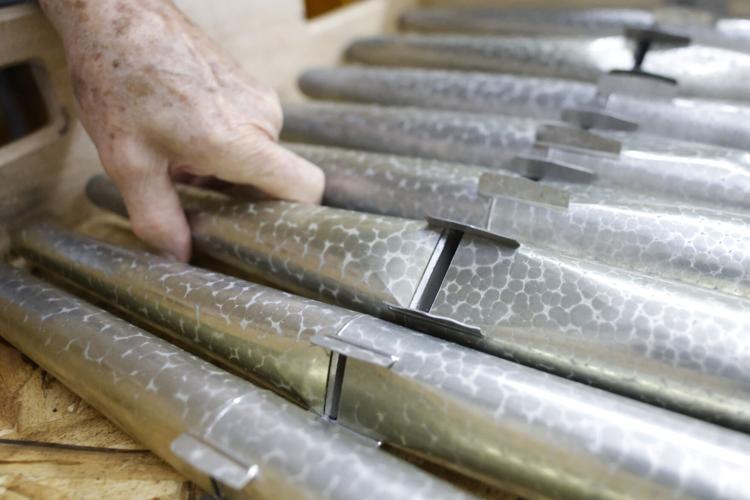
Rodney Levsen Sr. shows off metal organ pipes at Levsen Organ Company on Friday, Oct. 6, in Buffalo. The company regularly tunes about 300 organs throughout the country.
“It’s like the difference between going to a hamburger joint or going to a cafeteria, where you have all these different things in front of you and you can select what you want,” Levsen said. “On a large pipe organ, it’s sort of that way. You can select whatever tone colors that you want to create the sort of music that you’re working with.”
The more pipes and more ranks of pipes an organ has, the more versatile it can be. Each pipe is a different size, with the smaller pipes creating higher pitches and the larger ones creating lower pitches. Most organs are arranged diatonically, which means the larger pipes are in the middle and the smaller ones are at the end.
The belly of the beast
Over the last several decades, big changes have come to the organ industry. Fewer churches are being built, which would typically translate to fewer organs to build new ones. However, larger churches have shifted their focus to repurposing unused organs.
In the Levsen workshop currently is an organ from a small church in Monmouth, Illinois. It was purchased by Notre Dame Catholic Church in Chippewa Falls, Wisconsin, and is being expanded and updated.
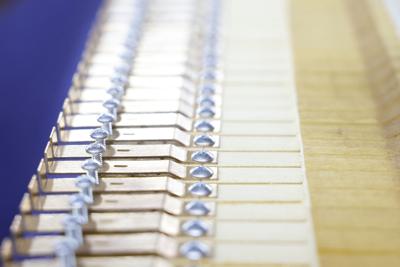
Pieces of the organ are spread out in the factory and are switched from pneumatic action to electric valves. Pneumatic organs were popular at the turn of the 20th century and had leather pouches that covered the valves to help control the airflow. Their life expectancy is about 15-50 years, depending on the environment.
“If there are acids in the air in a highly populated area, the leather lasts a very little time,” he said. “If you’re in a little country church out on the hillside where the air is pure, the leather will last 50-60 years.”
Because the leather can wear out, many churches are opting for electric valves, which have a 100-year life span, Levsen said. Additional ranks are going into the organ as well, bringing the total to 30, or about 1,800 individual pipes when completed.
More ranks mean more pipes, both metal and wooden. The pipes work the same way but different sounds are accomplished easier with different materials.
“Bright, harmonic sounds are a little easier to do with a metal pipe. Mellow, soft sounds are easier with a wooden pipe,” he said. “Usually in a pipe organ, about one-third of the pipes are made out of wood. The rest are metal.”
Restoration on the organ started in September and is expected to be completed next spring. To buy the same one brand new would cost about $650,000.
“Notre Dame church is just pleased as pie that they can have this organ restored to like-new condition with all the new features, the digital control system, and 10 more sets of pipes we’re adding to it,” he said. “It’s a little more than a quarter of a million dollars altogether, as far as the project is concerned. But they are delighted.”
Once the restoration is complete, the parts and pieces will be carefully stacked on wooden crates and transported with Levsen’s own truck. A large organ can weigh as much as 12-15 tons — equivalent to the weight of about three elephants.
Getting in tune
Once the weather shifts from summer to winter, the focus of the business shifts to tuning. The Levsen Organ Company has more than 300 organs from coast to coast on its tuning rotation list.
Smaller organs can be loaded in about half a day, he said. Larger organs take two to three days to load. Once it gets to the church, the Levsen crew begins putting it together. Because they are so heavy, architects generally keep this in mind when the church is being built and reinforce the structure, or loft, for safety reasons.
Architects typically figure 400 pounds per square foot, he said. This is important for organs because they are spread out and the weight is distributed equally over the floor.
“If it has the capacity to hold the weight of people in the room, it has the capacity to hold the organ because the organ is spread out all over the place,” he said.

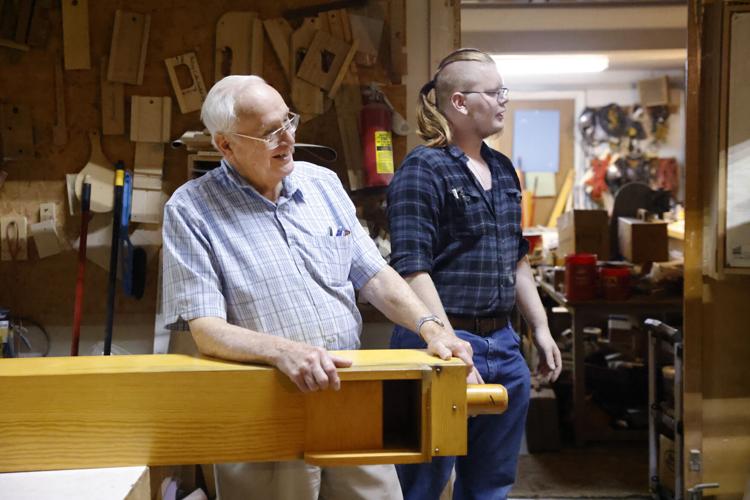
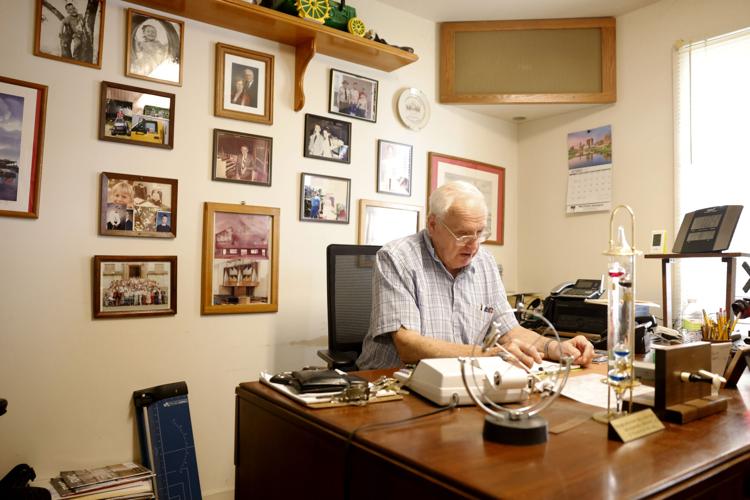
Rodney Levsen Sr. and his grandson and employee, Dustin Levsen, chat in the woodshop at Levsen Organ Company on Friday, Oct. 6, in Buffalo. Levsen's three sons also work for the company.
The average pipe organ needs to be tuned twice a year — once in the spring and again in the fall when the weather changes. Organs are classified as keyboard instruments but have woodwind elements due to how they work.
Air blows through the pipes to create the sound, but the pitch can be affected by the temperature in the room. If the room is too cold, the organ can go sharp. If too hot, it can go flat.
When churches turn off the boiler and turn on the air conditioning in the spring, for example, it needs to be re-tuned in order for it to adjust. The same rule applies in winter when the organ needs to be returned in a warmer environment.
“If you multiply that times 3,000 pipes, where each one of them is a musical instrument and to be in concert with each other, you need to have stable temperatures to make sure that everybody’s going to be on the same pitch,” he said.
Levsen said before his employees come to tune an organ, they ask the church to set the space at “worship temperature” for at least 24 hours. This allows the organ to get acclimated and stabilized in the new temperature to be tuned more accurately.
For the actual tuning process, some will use a digital device. Levsen, however, has been using the same thing for more than 60 years: his ears.
“It doesn’t take anybody special,” he said. “You just learn.”
From medieval to modern
Levsen said a big demand right now is digitizing organs to play by themselves because organists are hard to find. With this system, churches can share an organist without having one in the room during worship.
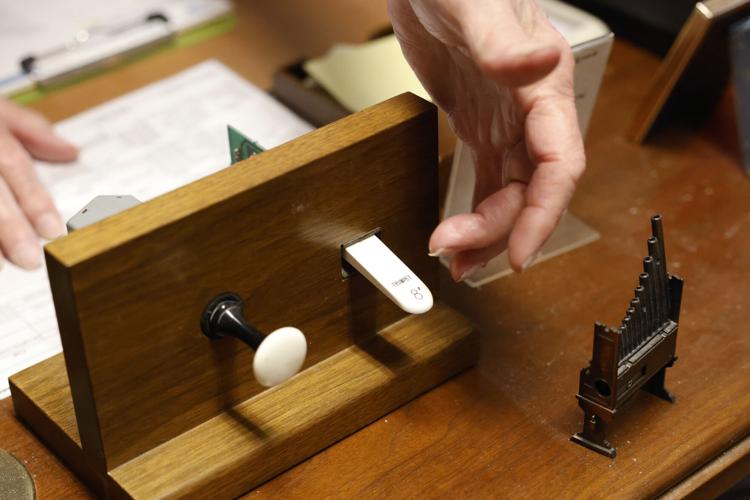
While the organist is playing, the music will be automatically copied onto a flash drive. When it’s time for church, anyone can press the button and the organ will play.
“It’s not a recording. There’s no speakers or anything like that involved, it just plays the whole organ,” he said.
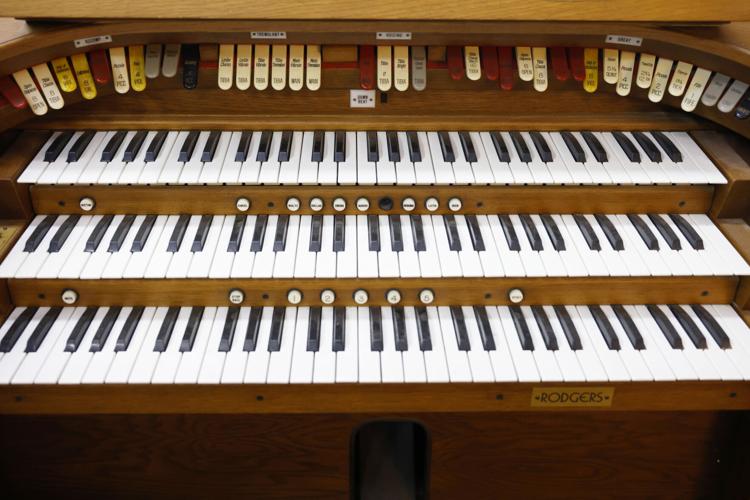
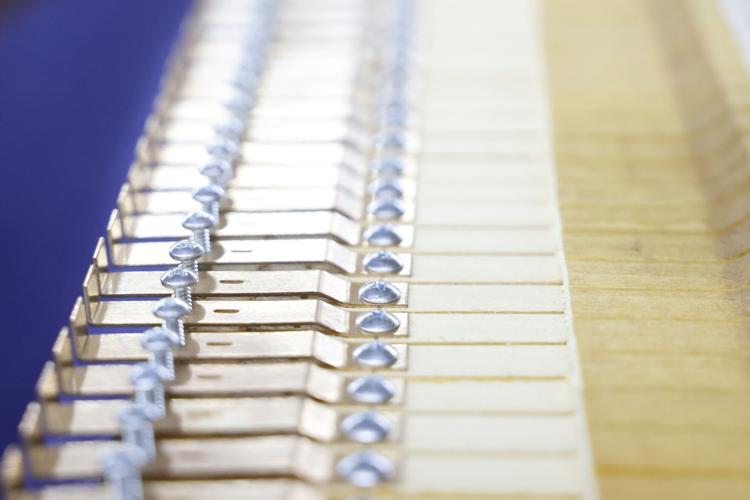
The keys on the organ do not necessarily go down as if there were a ghost player, he said. Instead, the keys open and close switches to conduct electricity into the organ and turn things on and off. Now, that can be done digitally.
Pipe organs have a history reaching back to ancient Greece where they were powered hydraulically, according to Yamaha. Later, devices known as bellows were invented in ancient Egypt. Wedge-shaped, air would flow through the bellows when they were compressed.
The air would then travel up through the pipes and produce sound. In medieval times, organ blowers would accompany organists. Their job was to use ropes and levers to compress the giant bellows and create more air for the larger organs.
Now, organs are fitted with electronic motors that pump the air into the bellows.
In another part of the factory is the drafting room where another son, Gregory, has his office. The design work is all done there first before the blueprints are taken into the workshop.
The process that once was done by hand would be completed on large pieces of paper spread out on the office floor. Now, everything is done digitally — a massive time saver.
“We try to get all of our instruments, drafting wise, done mechanically on paper before we pick up a saw or a hammer because if it won’t fit on paper, we can’t make it fit with the saw or hammer,” Levsen said. “Now we don’t even have to use an eraser. We have a delete key.”
Decades of dedication
In the workshop, employees know how to do everything from tune to making pieces to putting them together. The consoles, wind chests and wooden pipes are all built on-site. Originally, the plan was to build a metal pipe shop on the land as well, but that never came to fruition. And, it may be for the better.
“Pipe organ factories historically, have numerously, burned down because there’s so much different stuff that’s involved,” he said.
The metal pipes have to be treated with fire and so do many of the wooden parts. The Moline Organ Company was active in the area from 1879-1891. After the Illinois-based plant caught fire, the company moved to Milwaukee. A fire up there brought them back down to Moline, Levsen said.
No disasters have been reported at the Levsen plant, and he credits that to being careful and meticulous in their work.
Once tuning is over, they’ll go back to the projects at hand, Levsen said.
Those projects are what encourage him to get out of bed in the morning and what keep him working at 88 years old. Because at the end of the day, his goal is to help people fall in love with music the same way he did as a student at Madison School.
“The overall thing is to make a magnificent organ that makes goose pimples on your hands when somebody plays it,” he said.
Chris Nelson, the music director for St. Paul's Lutheran Church in Davenport, plays the organ on Tuesday, Nov. 14.
Insight-Levsen Organ Company
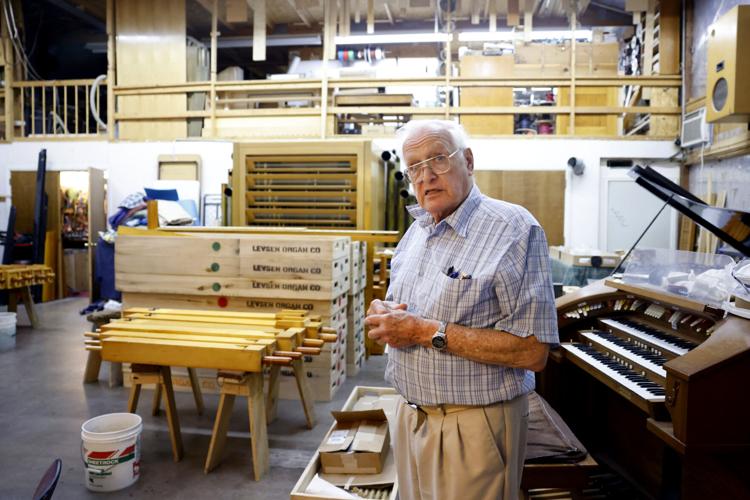
Rodney Levsen Sr. shows off his shop at Levsen Organ Company, which he and his wife, Colleen, bult in the '80s, on Friday, Oct. 6, in Buffalo. The company, which employs 10 people, builds, rebuilds and tunes organs.