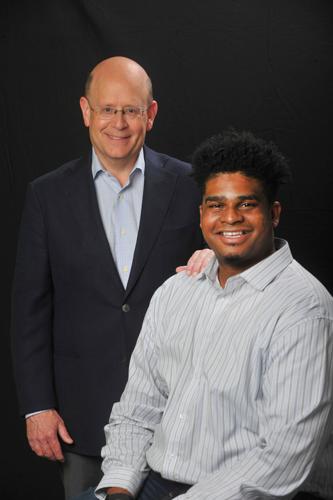



John Anderson, CEO at Quad-City Bank and Trust, and Ty Lewis, a new employee at the bank, meet at least once a month.
Ty graduated last year from St. Ambrose University. He starts his first full-time assignment at the bank in October. And he's already the new face of Quad-City Bank and Trust.
Ty is on the board at the United Way. He has speaking engagements slated for the fall. And to think, he almost left the Quad-Cities for Georgia.
John worked with the United Way, the African American Leadership Society and St. Ambrose University to set up a scholarship courtesy of the bank. The scholarship comes with an internship at QCBT. Ty is the first recipient.
Insight sat down with John and Ty last year to talk about the program. Was it successful? What's next for Ty? Here, an update on a scholarship program that continues to be the buzz of the Quad-Cities.
People are also reading…
MC: What’s happened since the last time we talked?
TL: Well, I was still in school, a senior, I believe, and finished my last year and graduated in May. Through that summer and last year, I was in credit admin, and that turned into a management trainee program where I did a rotational program around the bank. So over the last year or so, I’ve been getting exposure to different areas of the bank: operations, accounting, account executives, commercial lending, treasury.
I started full-time about three weeks after I graduated. October 3, I’ll get into my full-time position where I’ll be a credit analyst, doing write-ups, looking at credit, balance sheets, stuff like that. Hopefully, as I learn that, I’ll transition into more of a relationship role where I can be out in the community, more in a face-to-face role with customers, because that’s definitely my strong point. It’s been a pretty cool journey.
I had hiccups here and there, still grieving for my dad. But, definitely, graduation – John was there, he actually came to my grad parties. My mom from Georgia came up. It was amazing just for them to be in the same room. I had all my family and friends there.
JA: I got to meet his mother in person. I’d met her on Zoom, but not in person, so it was really neat.
MC: So in the past year, you’ve had opportunities to see Quad City Bank and Trust across all departments. Why was that important?
TL: One thing I realized when I jumped in, my main project in my internship was PPE, so all the loans given to businesses during COVID. I got exposure to a lot of businesses in the community. And I was talking to lenders, making sure applications were right, that the documents were there. It opened my mind, and I wondered what more there was to the bank and how all this comes together.
In April 2021, a correspondent bank of ours, the president had reached out to John and our correspondent team, looking to get their son, who was one day going to take over the bank, and they wanted to get him into a trainee program as well, where he would get exposure to the bank. I talked to our correspondent position, and I asked John if I could get more exposure in the bank. I was just thirsty for knowledge. It would be a blessing that I could do that too.
Things lined up, so I’ve been fortunate to meet a lot of people at the bank and learn a variety of different topics.
MC: Would you have stayed in the Quad-Cities if you didn’t have the opportunities at the bank?
TL: No, it was crazy. Looking at life, different things happen, turning points. I think everything happens for a reason. When I graduated from high school I was looking to go back to Georgia where my mom was.
(After considering multiple colleges and a few false starts), as all that was happening, I got the call from John. It was meant to be.
My dad ended up passing away that summer, so being in the community, having that village of people from the bank, from Ambrose, from my high school. I needed that. That all happened for a reason. As events started to happen, it’s like, you’re supposed to be here.
MC: You had a lot of off-ramps to leave the Quad-Cities, your father’s death, your mom in Georgia. But it sounds like you’re sticking around for a while.
TL: My last two years, I’ve been able to network, through the bank, through the rotational program. I’ve got connections at Ambrose, the United Way. I already had connections at Rocky, since I went to Rock Island. I have that village, that community, and I need that. I’m just looking forward to the future with that village. Like I told you, everything happens for a reason. I just want to elevate, the bank and the community.
MC: I remember the panic of being a college senior trying to line up a first job. You didn’t have to worry about that, did you?
TL: (laughs) I didn’t, but I don’t take that for granted, either. I’ve had friends at Ambrose who in the next couple months will figure out what’s best for them, maybe getting a master’s. I’m fortunate and blessed that I had that lined up. But, as John always tells me, too, I’ve earned that.
That’s how this management thing has worked out. I asked for more opportunities. I wanted to learn more. I tell John thank you, thank you, thank you, but he always says I’ve earned it. I’m very blessed, but I’ve also worked hard.
JA: I think what’s really cool is the networking that Ty has done. It’s unbelievable. Ty talked a little bit about correspondent banking and so Ty meets with the people who run correspondent banking for Quad City Bank. Ty, with this curiosity to learn more, says, hey, I want to go out and meet people. So he made calls on our corresponding bank network. We have about 200 banks that bank with us, and he went out and met people.
He wanted to know more about the IBA, so he picked up and called John Sorensen (CEO of the Iowa Banking Association). That type of passion to learn more is so impressive, and that’s Ty. All you have to do is stand back and see all the things he’s doing, including being on the United Way board. That’s just so impressive. To see Ty flourish is pretty cool.
MC: Sounds like Ty has run with the ball and done the work to hold up his end of the bargain.
JA: I might phrase that a little differently. It’s just simply someone opening a door. Then the responsibility falls to Ty. All we did was open a door and give him a chance. He had to take it from there and do all the things he’s doing. And I think that’s key to this. It’s not about the bank; it’s not about me. It’s just opening a door and letting someone who has the desire to do these things succeed. I’m just so impressed how he goes out and meets people.
To be able to see that, from my perspective, that opening of the door has enabled him to go after that maybe a little bit differently than he would have been.
MC: What value has Ty brought to the bank?
JA: Oh, my gosh. Ty is out and about and he’s a representative of this organization, from a cultural point, is trying to say. This is what we’re about. It’s not just about the basics of banking, making loans and deposits and that sort of thing. But’s also about being a good community partner. As a community bank, that is a big part of our mission. It is our mission. It’s the cultural piece that separates us, to some degree, from our nonlocal competitors. And when you have someone like Ty that says hey, I’m going to go out and live the brand and promote the bank – it’s hard to even put words around it. You certainly can’t put dollars around it. When you have someone like Ty who wants to be able to do that, it’s a great thing to know the opening of that door enabled that to happen.
Rather than lose Ty to a different community, we get to keep him here. Now, I would tell you that if Ty came to us tomorrow and said, hey, I’ve got the best opportunity for me in XYZ community, we’d say, hey, you’ve got to take that, and I think we have to be grateful for the time we’ve had. But we want to keep him here, though, because we want to see the benefit and the talent. And Ty’s right, his focus on interacting with people is really good. Some people have that skill set, and some people have other skill sets. Ty’s got that, and that’s a wonderful talent he has. We’re just happy he’s part of our team and out representing the bank in the community.
MC: The bank’s scholarship fund at St. Ambrose is now opening doors for others like Ty, correct?
JA: Part of that scholarship is to create an opportunity so that, not only are they getting the educational piece, but they’re getting real work experience. Deon Harrison is now here at the bank, now going through the program that Ty helped create, to some degree. It was new for us, and with every program you adjust it so you get more feedback, so Deon has been here now a couple of months. He’s a sophomore at St. Ambrose.
MC: Let’s say I’m a CEO. How do I lift something similar? Because I see the benefits. But wanting to do and doing aren’t the same thing.

John Anderson, a bank president and CEO, and intern Ty Lewis.
JA: I’ve actually met with the leaders of a couple of companies, and they’ve asked the same question. I say, here’s the model we’re using. It’s really through the help of the United Way and the African American Leadership Society where this all came together, plus our scholarship program at St. Ambrose and tying the two together. How do you do it? You ask your leadership. It doesn’t have to be the same. It can be whatever is important to your organization culturally, and maybe it’s a scholarship and work opportunity when you graduate. Or maybe it’s like ours, with a scholarship and an internship program. Or maybe it’s just a scholarship program. I think, to me, that’s the potential beauty of it. I think there are opportunities to do things, you just have to execute and do it.
Part of my personality is, it’s great to talk about stuff. OK, but let’s do something, though. And when you’re in a position to make something happen, do it. And, like us, we’re adjusting the program as we go. It isn’t perfect. We’re finding out, OK, maybe we need to spend more time working in this particular area, or maybe we need to broaden the approach this way. I think part of the whole process, or the journey, is you find that. If you sit back and never do it, well, then nothing is going to happen.
You have to continue to adapt to make a program successful. Like any business, we’re required to adapt, and that is what businesses do. And, to some degree, that’s what each and every one of us do in our own lives – adapt, so that we can continue to move forward. It’s a natural progression.
We need young people to stay in the Quad-Cities. We need that. There isn’t any reason why we can’t create ways to keep talent in the Quad-Cities. We need future leaders to stay. We need to talk more about it.
MC: Ty, what’s next for you?
TL: Finishing up the rotational program in October and starting as a credit analyst, and hopefully moving into a relationship role where I can be out on my strong point, being out in the community, growing the bank and bringing in other opportunities like I’ve had.
MC: Do you think Ty’s internship would have been different if he didn’t have a job opportunity waiting for him at the bank?
JA: The job wasn’t a guarantee. Ty had to earn it. It wasn’t a gift. If Ty didn’t perform, it wasn’t going to happen. That’s why I say all we did was open the door. The opportunity was there, but Ty earned it. He had to perform at St. Ambrose, he had to perform at the bank. And that’s all we ask of anybody. He took it and ran with it.
MC: Ty, do you feel pressure not to let people down?
TL: You know, at first, kind of. Obviously, with my dad passing and the program starting, it was new and the pressure was on me to perform. But over time and realizing, hey, you’ve just to come in and give it your best, and perform. I’ve done that, and over time I continue to learn.
As for as pressure, yeah, it was on me a little bit, but for me it was just perform. What really helped, was that my dad got to meet John, and how thankful he was for my opportunity. My dad got to meet John in February, and I think about that often. How grateful and thankful he was for the opportunity. My dad was just so happy. After the meeting we were in the parking lot, smiling, seeing him nod, and it was like, yeah, I’ve got to do this.
Pressure? Yeah. But I know we have people watching over me, and people supporting me from the Quad-Cities.