


The term "minimally invasive" has crept its way into the vernacular of medical terminology, but most people don't know much about it beyond the name.
At its core, minimally invasive surgery is done using a robotic device that assists surgeons in a variety of ways. At Genesis Health System in Davenport, surgeons adapted the technology early on and hit the ground running.
At the end of January, Genesis surgeons reached a milestone of completing their 7,000th robotic-assisted surgery since 2009. The hospital has 21 surgeons trained in the robotic-assist sector and led the state in the number of robotic-assisted surgeries completed in 2023.
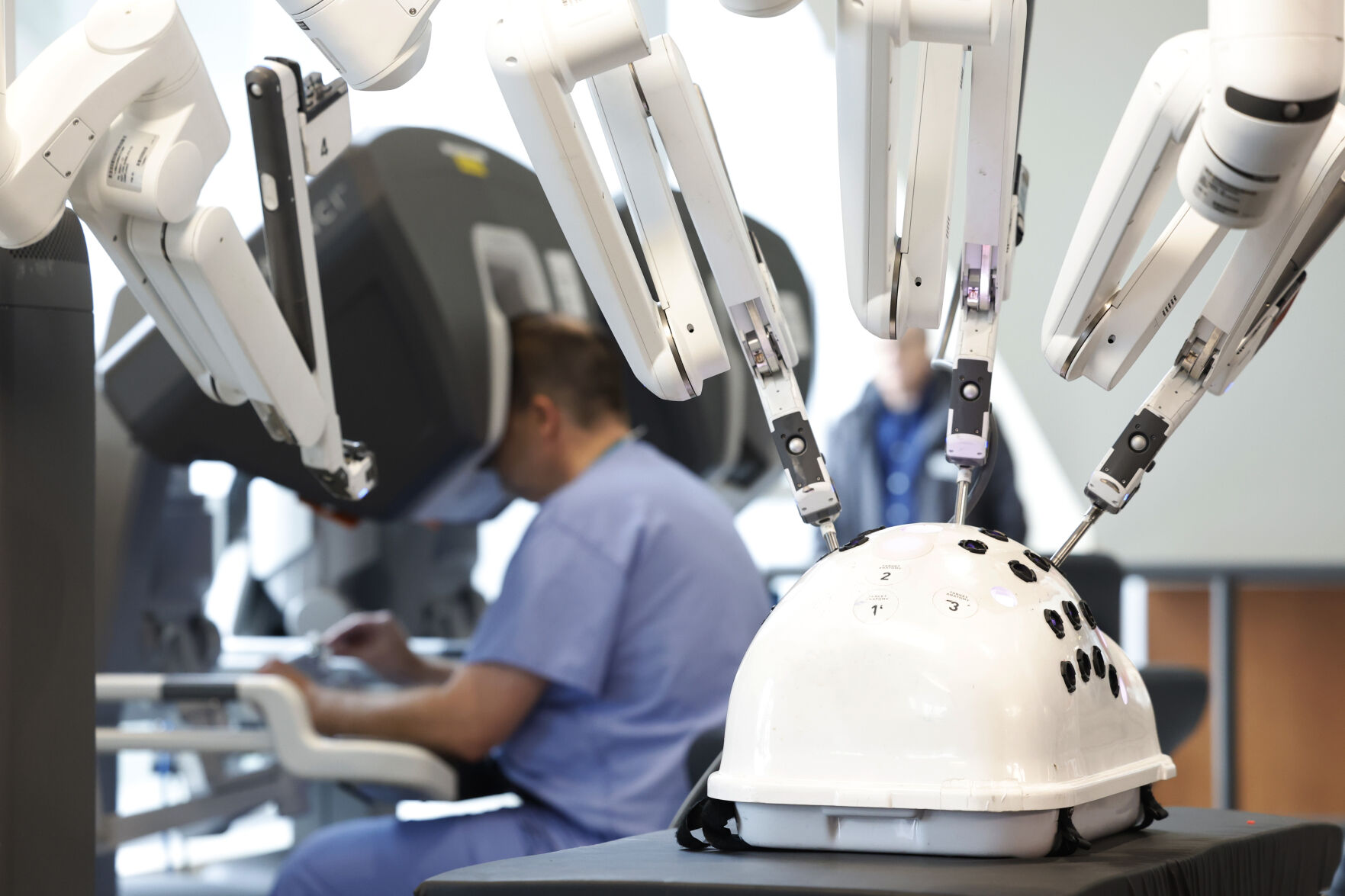
Dr. Robert Harson demonstrates how to use the da Vinci Xi robot on Friday, Dec. 1, 2023, at Genesis Medical Center in Davenport.
Working as a general trauma surgeon, Dr. Allyson Winter has been full-time at Genesis since September. Before her employment, Winter was a medical student at Genesis where the opportunity to work with robotics piqued her interest.
People are also reading…
"It is here at Genesis where I fell in love with surgery, and when I started to apply to residency programs it was very important to me that I select programs that would train me to be a competent general surgeon as well as give me the training I needed in robotic surgery," she said.
During medical school in Des Moines, robotic-assisted surgeries were talked about, but the physical opportunity to try was not available.
"It wasn't until I really lived through my surgery rotation here at Genesis that I was introduced to it," she said. "It's actually not a new concept, which is the wild thing. It's been around for over 20 years, but as with most technologies and innovation, it has evolved substantially over the last 20 years."
After graduation, Winter enrolled in a five-year residence program in Columbus, Ohio. By the end of the program, she was certified for both open surgery and robotic-assisted surgery.
Surgeons who have completed medical school and residency but would like to become trained on the robotic assists can learn through a program offered by Genesis. Director of Surgical Services Sue Jennings said the hospital contracted with Intuitive Medical, the company that manufactures the robots, to enroll surgeons in training sessions.
The training involves observations to watch other programs and both on-site and off-site sessions before a proctor comes in to monitor and evaluate the surgeon during a procedure. Staff assisting the surgeon during the surgery also must complete training within the robotics program, Jennings said.
Dr. Andrew Lightfoot has worked with Urological Associates since 2014, an independent group that has an affiliation with Genesis. When he graduated from medical school in 2007, robotics were not widely talked about, he said.
But it was offered some places, and the more he observed and saw how much easier the procedure was for the surgeon, the more he was interested in becoming certified.
"(Robotics) was the driving force to get me into the world of urology," he said.
After medical school, Lightfoot completed a fellowship in robotic surgeries, much like Winter. When he first came to Davenport, Genesis had one robot to utilize, and Lightfoot jumped at the chance to begin using it.

The da Vinci Xi robot on display at Genesis Medical Center on Friday, December 1, in Davenport.
Winter said the established robotics program at Genesis was a key factor in her desire to work for the Davenport-based hospital. Genesis currently has four machines, each of which can be used interchangeably for every procedure offered.
"Being able to perform robotic surgery is one thing, but having access to the robotic platform is another, and I think that is key," she said.
Patients who opt to take the minimally invasive route are usually enticed by the idea of a small incision. Winter said patients who underwent this type of procedure also benefited from shorter recovery periods, fewer complications and less pain at the incision site. And, they are not the only ones who benefit.
"It wasn't really until I became a surgeon and did hands-on training with the platform that I realized all the other advantages to the robotic system," she said. "Ergonomically it's friendly to the surgeon but most importantly the robotic instruments provide the seven degrees of freedom (of movement) the instruments can mimic what the hands can do; and the high-definition camera system provides great visualization.
Lightfoot pointed out that although it is referred to as robotic surgery, the robot is only the device used to facilitate the surgery.
"When you're talking about a robot what it really is, is computer-assisted laparoscopy," Lightfoot said.
Trained surgeons are completing the surgery but using the robot as an assist mechanism. In traditional laparoscopic surgery, surgeons look at a 2D monitor that shows the inside of the body cavity.
By using the robotic system, surgeons get a 3D look at what is happening, have the ability to reach further into the body and make precise movements. The machine is over the patient while the surgeon is to the side, looking through a monitor and moving controls to operate the device.
"Visualization is second to none," Winter said. "I have better mobilization and articulation of my instruments for the (surgery), but that visualization is key."
Urology has kicked open the door to the robotic-assisted surgeries, Jennings said, adding that Genesis performs prostate procedures only using minimally invasive techniques. That has been the standard for years, with Lightfoot adding the last time he did an open surgery was 2016.
"This is the standard, and in my mind you're not going to go back," Lightfoot said. "You're going to grow off what is present."
In the general-surgery sector Winter traditionally performs minimally invasive gallbladder and hernia surgeries, for example, and in the acute care setting small bowel obstruction or perforated ulcer disease. Other colleagues do specialized cases such as bariatric or reflux operations on the stomach.

Patient Lois Nichols sits in front of the da Vinci Xi robot on Friday, Dec. 1, 2023, at Genesis Medical Center in Davenport. At 91, Nichols underwent colon surgery with Dr. Robert Harson at the helm of the da Vinci robot.
Genesis offers hundreds of minimally invasive procedures, Jennings said, adding the hospital typically schedules about 35 per week between general surgery, urology and genecology. Winter said the number was slowly rising because of the benefits of the surgeries and patients slowly becoming more comfortable with the robotic assist.
The general surgery service line alone has seen a 26% increase in robotic-assisted surgeries — the largest percentage of the three service lines offered at Genesis.
"When I'm talking to patients and their families in the preoperative setting, it's not often that I'm offering a laparoscopic or robotic or open surgery," Winter said. "We sort of talk about minimally invasive surgery versus a traditional open approach and it's a shared decision using my best medical judgement to educate them on which might be best."
By now most people have heard of the procedures, Winter said. The questions revolved around the details, but few are put off by the term robotics.
"Almost everyone has a friend or family member who has had a robotic surgery by now," she said. "It makes it easier to discuss the pros and cons."
Lightfoot echoed that sentiment, saying he rarely brings the topic up.
"It's not even a discussion. They are almost coming to us," he said. "They are pushing it because they have heard about it, they understand it and have had a neighbor or a friend who has had it done and they see how well they do and want to have it done the same way."
But not everyone is seeking them out. Some land on the decision by necessity and find out the life-changing benefits on their own.

Dr. Robert Harson demonstrates how to use the da Vinci Xi robot at Genesis Medical Center on Friday, December 1, in Davenport. Surgeries that the robot can do include appendectomies, bladder surgeries and colon surgeries.
Patricia Gilbreath picked up her first cigarette at age 15. And she picked up her last one at age 59, after being diagnosed with lung cancer.
After losing both parents to lung cancer and being a decades-long smoker, Gilbreath had been coming in yearly for a CT scan.
Those CT scans were normal, and they had always come back normal for Gilbreath — until fall 2023 when her biopsy came back cancerous. It was found at Stage 1.
That year her pulmonologist at Genesis used the minimally invasive robot to search deeper into her lungs than previously was possible.
Diagnosing lung cancer requires a biopsy of the lung nodules in the outer third of the lung, which is nearly impossible to reach with a traditional bronchoscope. The robot uses an ultra-thin needle to get into the tightest areas of the lungs and retrieve a biopsy.
The procedure took about 45 minutes and had a complication rate of 1-3%. A few days after her procedure, the results came back, and she learned she had cancer.
“It’s devastating. Your life is put on hold, and you think you’re done for,” she said.
Lung cancer accounts for one in four cancer-related deaths. One in 16 U.S. citizens will experience a lung cancer diagnosis, with a five-year survival rate of 23%. But, if found at Stage 1, the survival rate increases significantly.
For Gilbreath, the early diagnosis likely saved her life. As soon as she was diagnosed, she quit smoking and shortly after was cancer-free.
“This is a second chance,” she said. “I feel like I have my life back again.”
Genesis highlights its ion robot in December, 2022.
PHOTOS: Genesis Da Vinci Robot

Dr. Robert Harson demonstrates how to use the da Vinci Xi robot at Genesis Medical Center on Friday, December 1, in Davenport. With robotic surgeries, there is minimal post-op and a fast recovery time for the patient.
Patient Lois Nichols sits in front of the da Vinci Xi robot on Friday, Dec. 1, 2023, at Genesis Medical Center in Davenport. At 91, Nichols underwent colon surgery with Dr. Robert Harson at the helm of the da Vinci robot.

The da Vinci Xi robot on display at Genesis Medical Center on Friday, December 1, in Davenport. With robots, surgeons have more precise control over fine instruments.

Dr. Robert Harson demonstrates how to use the da Vinci Xi robot at Genesis Medical Center on Friday, December 1, in Davenport. With the robot surgical systems, the operating room team can see the surgery in 3-D as opposed to 2-D.

Cancer survivor Lois Nichols chats with Dr. Robert Harson at Genesis Medical Center on Friday, December 1, in Davenport. The medical center has four systems used for about 25 different surgeries.
Dr. Robert Harson demonstrates how to use the da Vinci Xi robot at Genesis Medical Center on Friday, December 1, in Davenport. Surgeries that the robot can do include appendectomies, bladder surgeries and colon surgeries.