







Last year was a milestone moment for women leaders. The number of women CEOs at Fortune 500 companies set a record high at 41, double the number from a decade ago. In 2001, there were just three.
Despite big gains, women in the workforce continue to face obstacles their male counterparts just don’t encounter. Those 41 women on the Fortune 500 list account for just 8.1% of CEOs. Women workers have been disproportionally affected by the pandemic, when at one point, the labor force participation rate among women was at its lowest point since 1988. And pay inequity also continues to be a major obstacle for female workers, even at the top of the org chart.
In the Quad-Cities, women who worked full time, year-round earn on average $14,847 less than men who also work full time, year-round, according to the most recent census figures.
For perspective: If the Quad-Cities pay gap were ranked against all 50 states and D.C., it would rank 49th, ahead of only Wyoming and Louisiana.
People are also reading…
Two factors might be driving the local gap. One is growth in male-dominated industries like architecture, engineering and manufacturing, which saw gains in their share of the overall job market in the past decade. A second, harder-to-measure factor could be what one female CEO in the Quad-Cities called not so much a “glass ceiling” but a “broken first rung” on the corporate ladder.
Women traditionally haven’t gotten their chance to prove themselves.
While the Quad-Cities still has plenty of work to do when it comes to diversifying its C-suites, the region is on track for progress, too. Just this fall, three women were promoted to high-profile leadership positions in the Quad-Cities.
Insight spoke with each about the unique challenges faced by women leaders, and perhaps more importantly, what the community can do to foster more diverse and equitable leadership.
“We often believe, especially as women, that we have to have the perfect resume, or that we have to have all the skills that are requested in the job description,” said Amy Novak, the new president at St. Ambrose University. “In reality, it's not true, and most men who apply for those jobs don't have all those skills, and yet, we discount ourselves before we even get through the door.
“So I say to women all the time, You don't have to have all of these, you have to be really good at some of them, showcase those, take the risk to try something new.”
Executive recruiting firms say they see increased interest from companies for women leaders, particularly as research shows that having a more diverse company leads to better results, the Associated Press said in its latest annual review of top business earners.
“It’s just good business,” said Jane Stevenson, vice chair at organizational consulting firm Korn Ferry. “It’s no longer a ‘Should more women be in business?’ More diverse pipelines produce better outcomes. As more businesses prove it can be done over time, then positive peer pressure kicks in.”
Mandy Parchert is a workforce development business partner at HNI Corporation and a member of a local Lean In circle, a group of female peers who meet regularly for discussion and support.
“I believe women have the same opportunities as men, but the issue becomes, do women and other minorities know how to reach their aspirations when they don’t see as many people that look like them in certain roles?” Parchert said. Spaces like the Lean In circle, she said, help women feel confident in attaining their goals.
Said another Quad-Cities female CEO: “We need simply to be willing to talk about it. They can be awkward or difficult conversations. But it’s a good first step.”
Meet the newest leaders
Kate Jennings
Executive director, Q2030
Started: Aug. 2
Q2030 began as a call to action for Quad-Cities businesses and leadership groups to make our community a better place. The goals and structure have shifted over time, but Q2030 recently took a huge leap forward by establishing itself as a non-profit and hiring a director, Jennings. Her prior experience includes serving as deputy chief of staff and district director for Congresswoman Cheri Bustos.
Highlights:
Over the past 15 years, Jennings has worked with Senators Richard Durbin, Roland Burris and Barack Obama to create and implemented strategic policy, serving as the primary liaison for those offices with community leaders, businesses and other elected officials.
Jennings also planned regional and local outreach aimed at convening diverse groups to identify challenges and coalesce around shared goals.
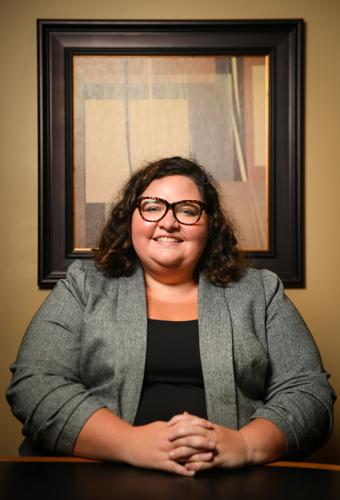
Amy Novak
President, St. Ambrose University
Started: Oct. 1
Novak earned her bachelor’s degree from the University of Notre Dame; a master’s degree in economics from Wright State University and a doctoral degree in interdisciplinary leadership from Creighton University. Before taking the top leadership position at St. Ambrose, she was president of Dakota Wesleyan University, where she grew enrollment by 20% during her tenure. She’s also mother to eight children.
Highlights:
She previously served in multiple administrative roles at DWU, including as provost and executive vice president from 2008-2013; vice president for enrollment management; dean of enrollment management; and director of student support services.
Novak led two capital campaigns that raised nearly $60 million dollars, most of which supported building initiatives on DWU’s Mitchell campus.
Novak spearheaded the university’s efforts to launch its first online, hybrid, and graduate programs: an LPN-BS program; an MBA program; and a M.Ed. program.
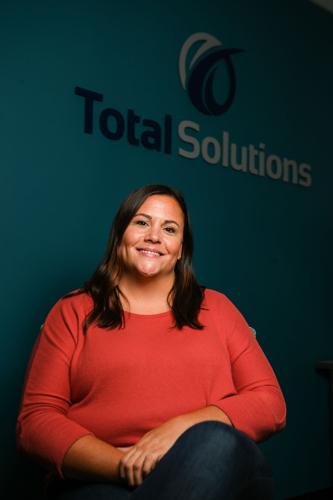
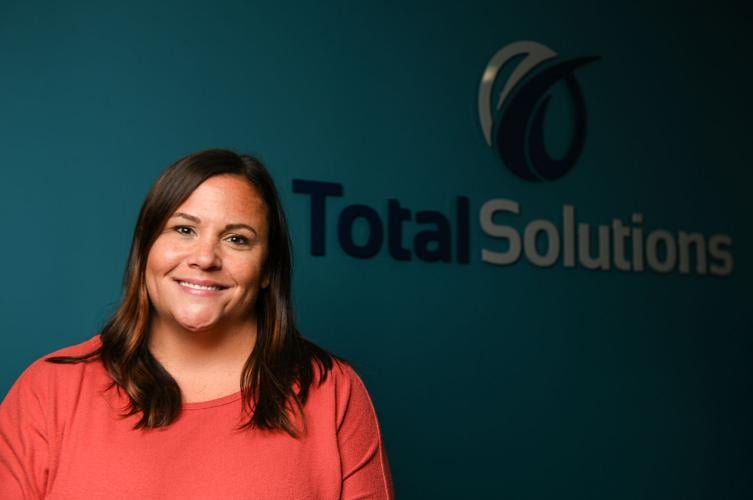
Kristin Glass
President, Total Solutions
Started: Sept. 7
A former chief strategy officer at the Quad Cities Chamber of Commerce, Glass is taking on her first job leading a major local company. At Total Solutions, a firm that offers business support like accounting and HR services, Glass leads a team of 17 that serves over 100 clients throughout the Quad-Cities region and beyond. Her role focuses on setting the strategic direction, identifying new opportunities and creating a culture of engaged employees.
Highlights:
Glass spent 15 years at the chamber and has a deep knowledge of the Quad-Cities economy.
She is a Quad-Cities native and St. Ambrose University graduate, a recipient of Leaders Under 40 and a graduate of the Institute for Organizational Management.
Overcoming the broken ladder
Novak: “When we look at higher education today, particularly in private colleges, and among presidencies, there are far fewer women in those roles than there are men. I think at last count, about 25% of the small private colleges in America were being led by women. So one might ask what causes that situation, and I think it's oftentimes, perhaps, our inability to see ourselves there, that's a barrier. So it's our own inability to say, 'We can do this,' or we have the courage to step into that role, even though we don't know everything, and network ourselves in such a way that allows us to leverage those networks and experiences to strengthen our capacity to be in those roles.”
Glass: “I think being a woman business leader is one thing, but also a young woman business leader, you have to work hard and prove your worth. And I'm fortunate to have many leaders in the past that have seen the work ethic that I have, and I've been able to overcome being a young, female, mother, leader. Those are three hard things to overcome. And I've again been fortunate to have leaders who see that the hard work I put in and the leadership I demonstrate, nothing else matters. But I have had, in the past, I've experienced that where sometimes you're labeled as a mom, or you're labeled as a millennial, or you're labeled as a female, and you just have to kind of set that aside and prove what you're able to do. In today's world, everyone has challenges and things that they have to face. Right now my challenge would be proving that I'm able to do this new role that I'm in that's brand new, that's completely different from what I've done the last 15 years. But I don't feel like I'm at a point where I'm defending or labeled as a mother or a young female leader. So it's more a challenge by demonstrating my abilities.”
Jennings: “In the past, people sometimes looked at women like, OK, what do you bring to the table? And I've always just believed that the hard work proves that you are responsible and can take on whatever duty that may be coming toward you. I have been very lucky with Q2030. Women still face barriers in being up the career ladder. And I hope that initiatives like Q2030 can help.
Developing more women leaders
Glass: “Say yes, when you can, and have confidence with yourself that you can do it. When you do say yes, a lot of times you'll surprise yourself with what you can learn and what you can do, and it'll open up a lot of new doors for you. Getting comfortable in what you can do and trying new things is a big transformation in your career.
Novak: “Take the risk. Try something new or different, and have the courage to try and follow it through. When doors open, don't be afraid to explore that possibility. And oftentimes, that requires us to get out of our comfort zone, and that's not always terribly comfortable, but the yield, and the outcome of that can be remarkably positive. And I think it allows us to broaden our capacity of both knowledge and our network and who we're exposed to.
Jennings: “Find strong role models. I have had role models in my professional life that crossover into my personal life, and that strong core of women who I know, I can go to for advice. You know, when you're having a difficult day, they can pick you up, they're always your cheerleader. And I've just found those people in my life to be invaluable for my personal and professional development.”
How to help
Jennings: “Really look at your company, groups or organizations you’re involved in and identify, are there leaders that are being left out? Or are there people that could, with a little bit of training and a little bit of mentorship, reach a new level of leadership? And really just be intentional about helping to build people up, whether it's women or people of color, or any other underserved population.”
Novak: “I think always being mindful of creating diverse work teams is really critical to the work we're doing. There is tremendous amounts of data in every sector that says, When our team represents a diverse group, whether that's people of color, that's people from different backgrounds or ethnicities, that's women, around the table, people of different genders. When we're able to have teams of people and amplify their efforts, we're going to be more successful in any organization. So I think the question really is who's around our table? And one of the things that has been a theme here, for me personally, in the last two months has really been how do we invite all of those voices around the table so they can be part of decisions, so they can be part of conversations, we can understand and appreciate alternative perspectives. So I lean into this concept of bringing everyone around the table because I know the outcomes when we invite participants to be around the table who are different than ourselves, usually yield very positive outcomes for an organization.”
Glass: “I think prioritizing diversity of all types in hiring and giving people a shot and really expanding networks to be able to go beyond the traditional business leaders’ network to help women and minorities step outside their normal comfort zone and try new things. It requires us to think differently and act differently.”