

People turn to Crawford Co., based in Rock Island, for all types of business solutions. On any given day, a Crawford employee might be installing new plumbing in a home, designing an HVAC network for a commercial business, building a brew tank for a craft-beer brewer, fabricating a metal part, crafting an architectural feature or engineering an electrical system.
Founded by Harvey Crawford in 1952 as Crawford Heating and Cooling, the company spent the first half of its existence specializing in residential work. But since the 1990s, Crawford has been in a consistent growth pattern, acquiring new companies and technologies in a diversification strategy that’s built the company into seven divisions operating out of nearly 100,000 square feet in three locations, including one outside the Quad-Cities in Dubuque.
Diversification started with a weld shop in 1986, during the farm crisis, when business was down everywhere and the company needed new revenue streams. Since then, Crawford’s acquisitions have come more out of opportunity than necessity — Crawford has sought to acquire businesses and technologies that fit well within the company’s existing portfolio of services, while at the same time expanding what the company can do and offer to customers.
People are also reading…
Crawford took another major step forward in 2000, purchasing the area’s largest laser cutter and launching a new laser division. That same year it added subsidiary Monoxivent, a “source-capture” system that filters vehicle exhaust from inside buildings. And in 2010 it opened a plumbing division.
Crawford continues to diversify today, recently as a provider of beer-brewing tanks, and last year, acquiring Seaberg Industries, specializing in machining and fabrication, as its latest division.
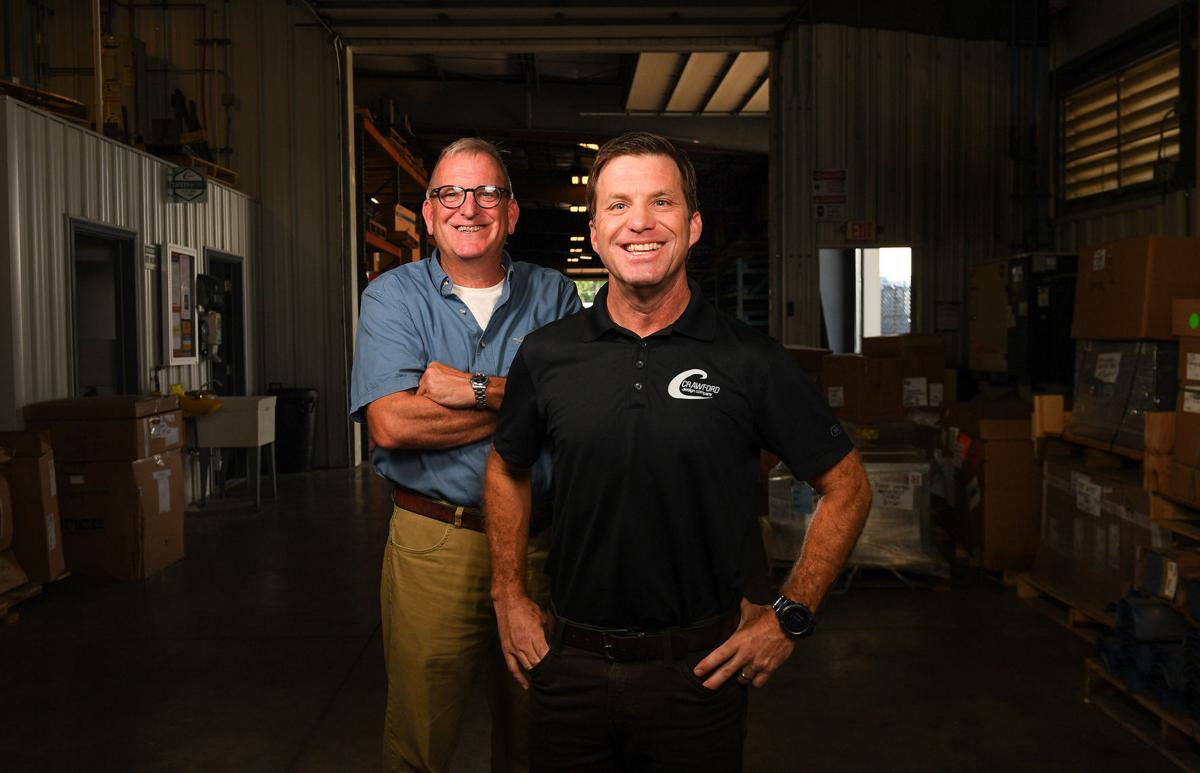
The company is run by Ian Frink and Jim Maynard Jr., whose fathers both had careers at Crawford. Larry Anderson is the company’s CFO.
Frink recently invited me to the Crawford headquarters for a chat about growing his business.
What were the circumstances that led you to begin diversifying Crawford?
IF: In the ‘80s we started getting into fabrication, so that was the first time we diversified. That became a real area of concentration at that point. We started with the HVAC, and that carried us through the ‘80s. And then the economy was kind of taking a hit at the time and we thought welding and fabrication was a good move. Being a member of the sheet metal and fabrication union made it a logical fit because not only do they do the HVAC, they have a welding training program.
That worked out well, and kept getting into bigger and more unique jobs and expanded and grew. We rode that up until about 2000.
The company really seemed to kick into overdrive at that point. What was it about some of those acquisitions that made them good fits for Crawford?
IF: A company called Monoxivent, who was founded in 1953, had relocated from Michigan to the Quad-Cities, that came open for sale, and we thought, OK, here’s another opportunity for diversification. We can make a lot of these products with our welding division, and they have a good reputation throughout the United States. And we bought them and ramped up their rep base, tweaked a few things, updated marketing materials, got more aggressive with advertising and grew that company.
In 2001, we brought on some laser cutting, which made a lot of sense, because if we’re welding and forming, well, now we’re cutting the metal, right? So you’ve got a process start to finish. You can cut the metal. You can form the metal. You can fab the metal. And then that can feed into Monoxivent. You know those hose reels we saw (earlier in the shop)? Perfect example. Now the production team’s assembling that product to ship.
With the HVAC, a lot of contractors also do plumbing, so plumbing came our way shortly thereafter. We’ve grown that and done a lot of good plumbing work to the point we have 50 employers who are plumbers.
With so many specialties within the company, talk a little bit about your workforce. Where does it come from? And how do you and Jim manage across such a wide scope?
IF: The most valuable assets we have here are our employees. We try to be strategic about who we hire, and guide them initially. Jim and I are pretty hands-off. We try to let (division managers) run their departments like they were their own companies. When they need help, support, assistance, if we’re looking to grow or add large equipment, that’s where Jim and I come into play and do some strategy.
We got serious about business planning in 2011 with St. Ambrose University, which has been a great help for us. We’ve found that planning out short and long term and checking ourselves and reassessing was a good step. Everybody buys into that.
So I think the good people, the planning, the communication, not micromanaging, trying to give people ownership — those have been key to that diversification. When you’ve got some champions in the company who can build some camaraderie and teamwork, then that next expansion or diversification, people want to help.
What’s been the driving force behind your diversification strategy, and what criteria does Crawford use to consider when to make an acquisition?
IF: Diversification is good for us because we don’t have all our eggs in one basket. So, if the construction market is soft, we have fabrication. If fabrication is soft, we have manufacturing.
When we look at our financials every month, quite honestly, it’s rare we have all divisions in the black. Usually five of seven or six of seven will be. But it helps that we’re all one company and the cash flow moves throughout the organization. It gives us flexibility.
And some things are seasonal. The first quarter is sometimes soft because construction isn’t happening in January, February and March. But Monoxivent, the fab division is busy. That helps us from a sustainability standpoint.
The brew tanks were a recent opportunity. Front Street Brewery needed some microbrewing equipment, some fermenters, and had long lead times from China. We said, hey, we can make this with our plumbers, our fab division, we can figure this out.
And it worked, and Front Street had its problem solved. And then, we were like, this is a good product, so we made a website, set up marketing, and we’ve done 100 breweries since.