



Estes Construction has been associated with quality and integrity since Jim and Lori Estes started the company nearly 50 years ago with four guiding principles: advocacy, value, responsiveness and leadership.
Estes builds churches, homes and hospitals, corporate headquarters and car-dealership showrooms. And schools. Lots of schools. Since 2009, Estes has been Iowa’s only “preferred provider” endorsed by the Iowa Association of School Boards for construction services.
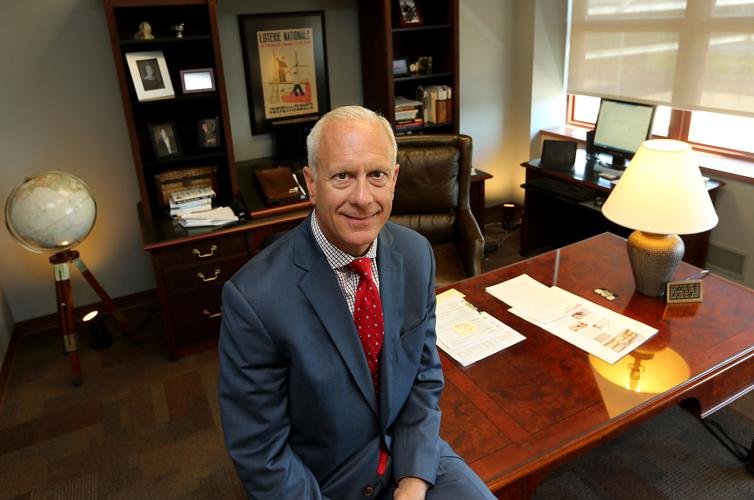
The company’s founding values still guide Estes’ business decisions, but they’ve also come to define what the company stands for outside the boardroom. Much of that is thanks to Kent Pilcher, nephew of the original founders, who has grown Estes into a company now nationally recognized for its corporate culture.
A sponsor of many community events and initiatives, Estes is a poster company for the kind of modern business that aims to balance profits with corporate responsibility, its brand with its ethos, its employees with its communities.
People are also reading…
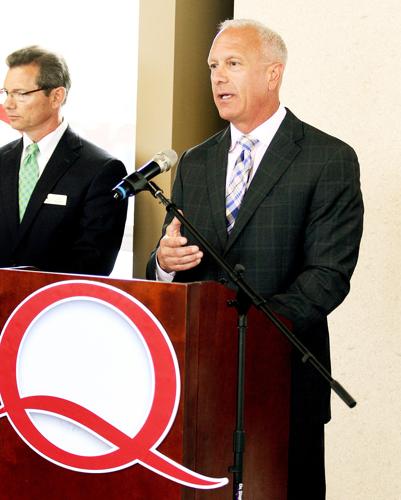
And as CEO, Pilcher walks the walk. He’s served on community boards, committees and councils too numerous to list here, and has been a high-profile advocate for some of the Quad-Cities’ most vulnerable populations, notably through his role in the African American Leadership Society.
These days, Pilcher has a special focus on developing the Quad-Cities’ community leaders of tomorrow.
We caught up recently to talk shop, and as is typical when I hear Pilcher speak, I came away a feeling a little wiser.
MC: Do you see yourself as a businessman who is a community leader, or a community leader who happens to be a businessman?
KP: We’ll that’s an interesting juxtaposition. One way to look at that may be to ask if they’re mutually exclusive, right? I see them as mutually inclusive. As a business leader, you have a responsibility to the community, and as a community leader, you sort of have a responsibility to the businesses. In other words, those are very intertwined, and certainly what’s been good for the community has been good for business. I think in today’s world, for a lot of businesses who have good social responsibility programs, what’s good for business should be good for the community. So that’s a bit of a dodge to your question, but I think they’re so interrelated it’s hard to position those as one on one end of a spectrum and the other on the other.
MC: Perhaps they’re that intertwined in your mind, but maybe not every CEO sees it that way. What’s the motivator to get more companies to see value in community involvement?
KP: That’s a hard question and it depends on the CEO. Some CEOs really believe in it, and in the conversations I’ve had with those who don’t, I haven’t had much luck convincing them it would be in their best interest long-term to build a really strong community.
I’ve heard some CEOs say, ‘Yeah, but my company does more business outside the Quad-Cities.’ Well, so what? So does ours, but so what? That’s not the point. That’s a diversion.
MC: Did you have an epiphany? How did Estes come to find value in community investment and involvement?
KP: You know, my aunt and uncle believed in it, but as I started to get involved in the community in the late ‘80s, especially through Rejuvenate Davenport, I began to realize the work we were doing was making a real difference. And I also began to realize how much I was learning from being involved with other leaders on the same journey. And that evolved into, OK, this makes good sense for the company, and we benefited from some of the positions we took as a company. Some of it was that the involvement created good marketing. Some of it led to new business opportunities. Some of it was becoming an attraction where someone wanted to come work.
I think the last piece, now, is we push everyone in our company to get involved in some way in the community. And the reason we do that is because it helps the community but it also develops them. There’s intrinsic value in being part of something bigger than yourself and how it makes you grow. We try to attract and keep the people who want to learn and develop and grow, and it sort of self-selects, to some degree.
It’s like anything. You start with your own experience, it begins to make sense for the company, you see how much you benefit from it, and now you want to show others how much they can benefit.
MC: As you well know, building a corporate culture takes a lot of work, and leading by example. What’s been your strategy to get your teams all pulling in the same direction?
KP: I had a model from my aunt and uncle for a company philosophy. We were a growing company, and I had opportunities to grow, but I also had opportunities to fail. And they never kept me from failing. Failing is a dangerous word because it implies there’s no learning. I made plenty of mistakes, but the question was always, ‘Did you learn from that? And how will you apply that in the future?’ So that became the premise of how we build people. We give them training and background, yes, but we also try to put them in growth opportunities. You have to realize that sometimes things are going to go differently than how you want it, but the question is, ‘What did you learn here?’ We see people come of out things that don’t achieve optimal outcomes, but you’ve got to learn something. Our saying is: Fall down seven times, get up eight.
That sounds simple, but it’s the real premise of what we’re trying to do – put people in situations they can grow, and, hopefully, it’s a batting average.
MC: Do you take a different approach to senior managers who carry more responsibility?
KP: We have defined five different levels within our company and there are different paths through the levels. … So we try to be deliberate that everyone has pathways to develop. The further you go up these levels, the more soft skills you have to have and the fewer technical skills, which is really no different than your position. You might advance because you’re a good reporter, but at some point it’s not about how well you write, it’s all about how you lead and develop people.
MC: I’ll be the first to admit to learning more than a few lessons the hard way, in life and business. I get the sense that’s been true for you, too.
KP: A mentor of mine said, ‘One of the things you need to do is take time to put your feet up on the desk and think about things.” And, I’ll tell you, in my mind my reaction to that, ‘How can that be? I’ve got to get things done.’
The point is you have to slow things down and be deliberate. But it probably took me four years to really learn that. And now I’ve coached and worked with a lot of younger CEOs and the first three or four years, you’re drinking from a fire hose. You’re trying to get a feel for the organization, the people, the teams and what they want to do, and it seems like that’s about how long it takes before all of us come out of it and start to say, ‘Where do we want to help the organization move forward.’
MC: It’s easy to measure success in business – the numbers are right there on the accounting sheets. But success in life is harder to define. What’s your definition of success?
KP: For me, it’s three or four things. How am I seeing other people grow around me? How am I helping create opportunities for them, because, for me now, there’s more reward in that. Whether I can be directly involved or I’m helping indirectly through or other people or systems, the ability to grow an organization is really based on allowing people to grow individually. How are they failing and struggling, and can I remove challenges?
Some of that requires transparency and trust. We have a communications system with three levels of complexity, and the third level is you self-identify that you had no idea how to approach this challenge. If someone comes in and admits that, there’s a pretty high level of trust there, right? Financial success is an outcome. It’s on the right-hand side of the equation.
And, for me now, too, it’s a lot about family. I have two sons in the business and trying to create the right opportunities for them and whether they’ll stay with the business, I don’t know, and they don’t either.
The last thing, and this crosses over to community leadership, is the concept of cultural authority. Are you respected in the community? If you called somebody, will they pick up the phone? If you ask somebody to be part of an organization, will they support it based on a level of trust just because it’s you?
MC: What’s the Quad-Cities' best opportunity? Not problem, but where do you think we can affect the most change?
KP: We’re fundraising for Q2030, and right now, that’s really asking people to trust us because there really isn’t a track record. And one member of a board I talked to pointed out that the biggest growth in the Quad-Cities is coming from the immigrant community. I didn’t know that, but I’m not surprised. She says, ‘So what are we going to do to encourage more growth?’ And I tried to answer that the best I could by talking about equity and inclusion, but I really do think that’s our opportunity to grow, and I don’t just mean people. I think we have to ask ourselves: What kind of community do we want to be?


