


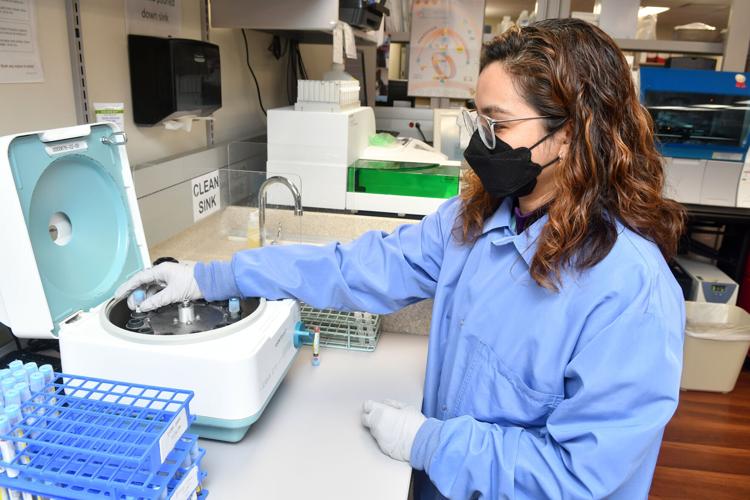
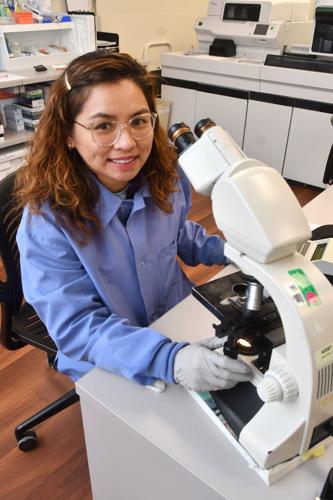
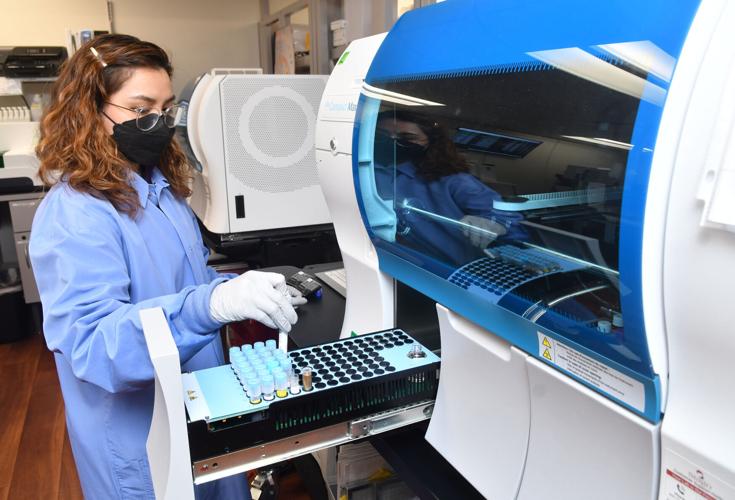
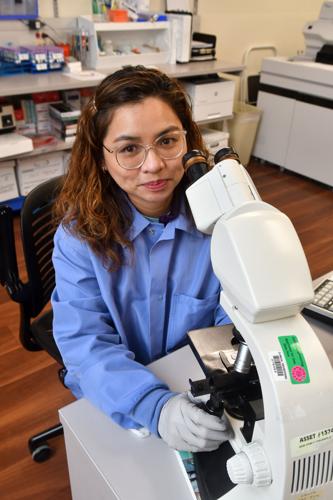
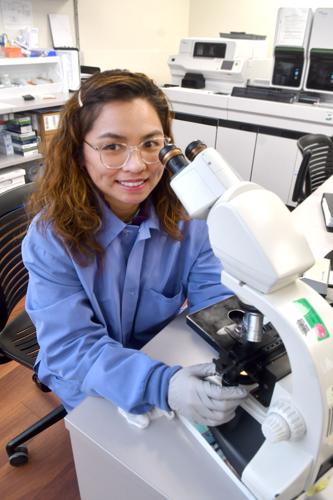
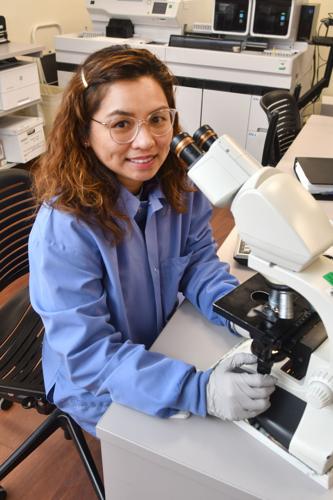
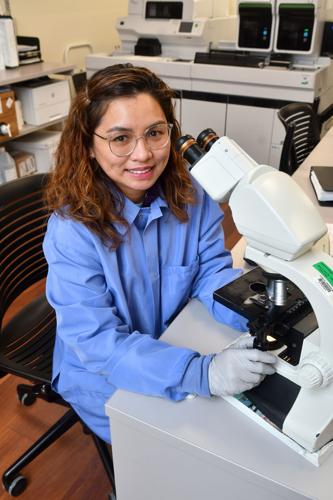
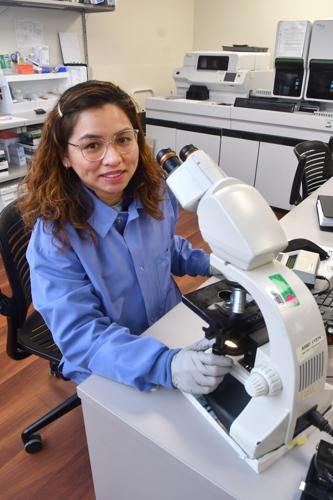
Jonnabelle Presentacion had never heard of Erie or Rock Island, Illinois. But she’d moved from her family’s home in the Philippines to Saudi Arabia to improve her English and become certified as a medical technician with the hope of a better future. By the time she’d passed all the exams and filled out the paperwork, she was willing to go anywhere as long as it was in the U.S.
Her destination? The Quad-Cities; UnityPoint Health was hiring in Rock Island.
Arriving in 2018 without knowing anyone in the area or how to drive, Presentacion relied on well-meaning coworkers for transportation and finding amenities.
“A car is a need, not a want here. It's kind of difficult to move around without a car,” Presentacion said. “So that’s one thing I’ve been helping them (new hires) with.”
Now, Presentacion is the technical lead for Hematology at UnityPoint Trinity campus in Rock Island, owns a home a quick walk from the medical campus where she works, and hopes to raise a family in the Quad-Cities with her husband.
People are also reading…
“When I started here, the thought was just that it would just be for experience but then getting to know the slower pace of living it's really nice, a good place to start a family or raise children,” Presentacion said. “..Because when you're in a fast-paced city, you always are tired, you don't have time to see how they grow, you are always busy and stressed.”
Immigrants and refugees like Presentacion, are among the biggest drivers of the Quad-Cities’ population and economic gains. Newcomers to our region are more likely to be of working age, between 25 and 64 years old. Immigrants are also more likely to open their own businesses and employ others than U.S.-born Quad-Citians. And they may be the region's best hope for growing population and entrepreneurship in the future.
Augustana professors Chris Strunk and Claire Bess studied the region’s 2020 decennial census numbers and most recent American Community Survey five-year data. One major finding: From 2010 to 2019, the population of the metropolitan Quad-Cities increased by just 1.1%, from 376,00 to 381,000, while the foreign-born population grew by 3,694, an 18.6% increase.
“The net effect, especially for places like the Quad-Cities, which have been losing population, especially on the Illinois side, for so long, immigrants really have a very positive impact, because they're providing so many resources, and creating jobs and doing jobs that most other people are not doing,” Strunk said.
In the past few years, however, tighter immigration policies and pandemic-related immigration restrictions and backlogs have put additional roadblocks in the paths of newcomers looking to come to relocate in the Quad-Cities. On the whole, some 2 million immigrants who'd otherwise have worked in the United States have been shut out of the country, according to a Business Insider analysis of census immigration data.
Locally, missing migrant workers are one layer of a complex labor landscape in which employers are struggling to find workers, especially in service, construction, and other fields considered essential.
“There's a huge slowdown in visa processing and a huge backlog in visas,” Strunk said. “And so this is really contributing to job shortages in areas where immigrants make up a really big part of the labor force.”
Overall visa issuance declined by 4.7 million in fiscal 2020, according to the State Department. Many would’ve gone to short-term visitors, but thousands would have gone to workers.
For some, the wait time is scheduling an interview. According to the State Department’s monthly numbers, more than 400,000 eligible immigrant visa applicants are waiting on an interview. In 2019, it was typically closer to 60,000.
New Americans in the Quad-Cities
New Americans in the Quad-Cities, according to the Augustana report, are more likely to work in manufacturing (40.3%), educational services, health care, and social assistance (13.2%), and arts, entertainment, recreation, accommodation and food services.
Most foreign-born Quad-Cities residents have been in the U.S. for at least 10 years. About 42% of residents are naturalized citizens, meaning they went through the application process and became U.S. citizens. That number is higher for newcomers who arrived before 2000 — 64.2% are naturalized citizens.
New Americans also spend quite a bit too, according to the Augustana analysis. Foreign-born Quad-Cities residents pay close to $15 million in annual state, local, and federal taxes, and have spending power (subtracting taxes from income) of $36.5 million.
“There's certainly some debate in the in the public about whether immigration helps or hurts the economy. I think, for the most part, though, economists, and I think we see this now that immigrants really have a positive impact on the economy,” Strunk said. “Immigrants tend to start businesses at much higher rates than native-born folks in the United States. And they're creating jobs at a higher rate than native-born people. And then there are a lot of positive multiplier effects, creating those jobs, but then also filling essential worker positions.
“We also see a lot of refugees who are resettled in other metro areas who choose to come to the Quad Cities," Strunk added. "Which I think speaks to the way that school districts and other institutions are doing a lot of good work in welcoming people and helping them find resources. My kids are in the Rock Island schools, I'm amazed at how they are incorporating a lot of kids from so many different backgrounds and providing a welcoming environment.”
New Americans are more likely to open businesses
Salvador Castañeda’s eyes light up when he talks about his vision for his new business. He plan to convert an old seed-operation complex into an establishment that blends salsa dancing, beer drinking, and coffee brewing. He and his wife hope to open this spring once the building remodel is complete.
He came to the U.S. when he was 7 years old with his parents on vacation.
“I like to joke around that we came on vacation and just we never went back,” he said.
Castañeda spent the rest of his childhood in Moline. He didn’t know any English, but remembers it being not too difficult to learn. Many friends and people in his school and neighborhood knew Spanish and helped him translate.
“I know that my parents went through very difficult times when we were growing up here in the U.S.,” Castañeda said. “But they did a really good job of hiding that from us.”
Before his family was granted amnesty under a Ronald Reagan-era bill that legalized most undocumented immigrants that arrived in the U.S. before 1982, Castañeda said his father would work long hours for less than minimum wage and his parents did whatever they could to hide the challenges from their kids.
“The story basically, is that in the beginning, my dad used to work a lot of hours but they wouldn't pay him very much because he wasn't a legal working person here in the U.S… He would go home with less money than what he was expecting, and I guess for I don't know for how long, but my parents used to basically go get cans out of the dumpsters for us to eat. But we never knew that.”
At 18, Castañeda wanted someday to own a nightclub. He joined the Air Force after graduating high school, and during his service he deejayed and taught salsa lessons for a short time. It fanned a flame to one day own his own establishment.
Now, at 47, after becoming a U.S. citizen, six kids, a move to Eldridge, and starting up an IT consulting business, he and his wife, Jessica, are opening the Granary, a brewery and coffee shop 219 N 1st St., Eldridge, that draws inspiration from their experiences traveling Central America and the Western U.S.
Castañeda attributes his entrepreneurship more to his personality and continuing interest in the business field, than how he came to be a U.S. citizen. His parents, though, he credits with molding him into a big dreamer.
Quad-Cities immigrants are more likely to start businesses
Nationally, first-generation Americans like Castañeda are more likely to open businesses and be self-employed. According to the New American Economy’s analysis of the American Community Survey, in 2019, immigrant entrepreneurs made up 21.7% of all business owners in the U.S., but 13.6% of the population and 17.1% of the U.S. labor force.
In the Quad-Cities, new Americans are slightly more likely to be self-employed entrepreneurs than U.S.-born Quad-Cities residents, 5.2% compared to 4.5%.
“A lot of times immigrants tend to have a lot of skills but they don't necessarily translate to the U.S. job market,” Strunk said. “So they may have degrees aren't recognized in the states or they may have certain sets of skills that that don't necessarily translate to jobs that are available. That's one reason we tend to see immigrants who are self-employed.”
Countless examples exist of newcomers opening businesses to fit a need not yet met, especially in the Quad-Cities.
Jean Baptiste, a Rwandan refugee, opened a transportation service that shuttled people to and from medical appointments after he noticed many newcomers without cars had difficulty making those appointments without reliable transportation.
Wilfried Ahokpe handles his own trucking operation from his East Moline home, setting his own schedule and contracts with his own truck, and shipping goods cross-country in a short-handed industry.
Ahokpe won a visa lottery to come to the U.S. from the West African country of Benin. He'd graduated college in Côte d'Ivoire with a degree in computer processing, and landed a job working as a contractor with the government. In a spur of the moment decision, he applied for a visa and to his surprise, won the lottery. When he first arrived in Virginia Beach, Virginia, he could only find a low-wage job housekeeping. He decided to keep looking, and moved to the Quad-Cities on word that there were higher-paying manufacturing jobs, like at Tyson Foods, that hired newcomers.
Now, he owns a home in East Moline with his wife and helped to grow and represent an organization of Beninese Americans in the Quad-Cities, which helps newcomers with job applications, growing their businesses, home-buying, navigating government processes, and building a familiar community of people from Benin.
Ahokpe said already he's advised four or five families on how to buy a house.
"I explained, you can do it too," Ahokpe said. "I explained to them that it is not very, very hard to buy a house. It is not very, very hard if you want to open your business. So, I share my experience with all of them so they know that they can also do stuff like that. To help themselves and their family and their community."
Organizations in the Quad-Cities exist that are dedicated to lending a helping hand to newcomer entrepreneurs: Mercado on Fifth, which hosts an outdoor market in Moline, serves as a resource and catalyst for minority entrepreneurs, and works with both English and Spanish-speaking entrepreneurs to help start and grow their businesses. In 2022, Mercado plans to open a new 6,300 square-foot indoor space with 5,000 square feet of adjacent patio space, according to Mercado’s website.
The Hispanic Chamber of Commerce, started in mid-2000s, likewise connects business owners with resources in Spanish and English. In 2018, the Des Moines-based Immigrant Entrepreneurs Summit held a workshop event for immigrant and refugee entrepreneurs in Moline. Blackhawk College offers a Food Protection Manager Certification class in Spanish. And general business resources, like the Western Illinois University Quad-Cities Small Business Development Center, help too.
Nationally, a 2018 study by the National Foundation for American Policy found that immigrants started 55% of the U.S.’s startup companies valued at $1 billion or more, or 50 of 91.
Strunk suggests the Quad-Cities add more resources for immigrants. “So, classes to help immigrants learn about all the ins and outs of starting a business in the United States," he said. "We could have more funding for ESL classes. I think, language barriers can be a huge barrier to either finding a job or finding a job that allows for social mobility.”
Quad-City businesses facilitate immigrant growth
Tyson Foods launched a program called Immigrant Connection, which puts Department of Justice-certified legal experts into plants with particularly large share of members that have an immigrant status to help them fill out work authorization papers to keep up to date as well as answer questions on applying for citizenship.
With the legal expert, the goal is to meet workers where they’re at and remove barriers to accessing legal expertise: needing to travel long distances, wait months for a local appointment opening, or pay thousands for that legal expertise.
“Really, the goal is to help them become more stable as an employee, help them improve their quality of life as a human by removing these immigration status barriers," said Garrett Dolan, a Tyson senior manager.
At Joslin, nearly half of the employees have an immigration status of some kind, Dolan said. And of Tyson's 120,000 hourly workforce in 30 states, about a third of those have some kind of immigration status.
Carolyn O’Connor from Esperanza Legal Assistance Center said on her first day in January at the Joslin plant, the immigrant connection team saw 15 people on a myriad of issues around work authorization and citizenship questions. They plan to only have 12, 30-minute appointments a day, so O'Connor said there was more engagement than they were expecting.
O'Connor said common questions included asking what to do about updated work authorization that they've been waiting on, which O'Connor said sometimes there are ways to help push the process along that the average person probably doesn't know about, or clearing up misinformation or hearsay about the citizenship application process.
“Some of the questions were around, I've already filed, but my stuff is sitting there. And there are avenues to push paperwork forward. They can take time, but very few people know about those methods," O'Connor said.
"One of the things that really made me happy about it was, you know, they come in with very big eyes, very concerned, very worried. And then they walk away with a smile of, OK, I've got someone in my corner," O'Connor added.
The immigrant connection program has certified legal people physically in-person in 40 of Tyson's roughly 115 plants, Dolan said. The remaining ones have access to legal expert appointments remotely. Dolan said Tyson reimburses the application fee and pays for the legal services.
"We often say the immigration pathway in the United States is like a maze with moving walls. And since Carolyn is always in that maze, and I'm always in that maze, we know what walls are moving," said Zach Szmara, executive director of Immigrant Connection.
International students choose the Quad-Cities to study
Lewis Moston remembers his first night at St. Ambrose very clearly. At 1 a.m., he’d just landed at the Moline airport, it was pouring rain, and he was locked out of the residence hall he soon would call home. But the story gets better from there, he said. He played soccer on a scholarship, and met and married a classmate. The couple now have a baby on the way. An internship turned into a job at Aronson Group, LLC, a Bettendorf-based insurance company specializing in transportation after he graduated in December 2019. He returned to England in March 2020 when his father died, just before the onset of a global pandemic, keeping him in England for an extended two month stay while he, to keep his visa, needed to keep working 40 hours a week, about 11 p.m. to 5 a.m., he said.
After his student visa expired, delays in getting work authorization meant he had to take a forced hiatus, unpaid, from work that ended up lasting 10 months. He got a green card six months ago.
At Augustana University, about 11.9% of its roughly 2,400 students in 2020 were international students. St. Ambrose enrolls about 120 international students each year.
Soon, Moston said, he hopes to begin applying for citizenship. With a family now here, he’d like to move more freely between the UK and the U.S.
“The cost of living here in Iowa is a lot cheaper than other parts of the country,” Moston said. “…In comparison, the cost of living is low and the income is a good start. So that's kind of why we're still here.”